
In the Age of AI, a Better Assessment Needs More Than a Better Question

Prakash Nagarajan General Manager - Marketing

A university lecturer asks students to evaluate competing investment proposals and justify a recommendation. The case study calls for judgment rather than recall, but assessing it consistently is demanding. Without common criteria and annotated examples, two instructors could award different marks for the same reasoning. Feedback may be equally uneven. The publisher therefore needs to develop considerably more than the question itself.
In earlier articles, Where Educational Value Moves in the Age of AI, When AI Can Do the Work, What Should Students Still Learn to Do? and From Content to Capability, we examined which cognitive capabilities learners must continue to practise as AI becomes more capable. That discussion now leads to a publishing question. How can content teams make reasoning observable and assessable through the materials educators use?
Why assessment content is receiving closer attention
At its October 2026 AI in Education Summit, Cambridge University Press & Assessment raised concerns about establishing what students genuinely know when AI can produce polished work. Cengage’s 2026 Graduate Employability Report points to demand for practical, demonstrable skills. The Renaissance and Carnegie Learning partnership connects mathematics assessment insights with curriculum-aligned lessons and practice.
These developments address different needs. Cambridge’s discussion centres on credible evidence of learning; Cengage’s research concerns applied capability; and the Renaissance–Carnegie Learning partnership links assessment information to the next instructional activity. For publishers, each raises questions about the resources needed around assessment tasks.
Building the complete assessment package
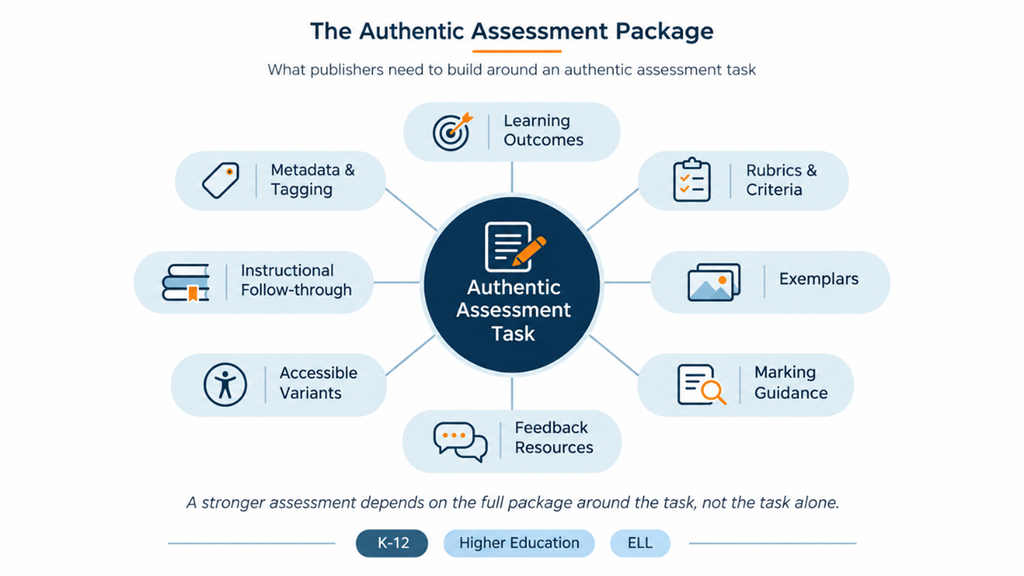
An assessment specification establishes the intended learning outcomes, prerequisite knowledge, level of difficulty, permitted resources and evidence the learner must produce. These decisions shape the materials that accompany the task and the judgments educators will make when reviewing responses.
A rubric must distinguish the quality of reasoning from the polish of the final answer. Annotated sample responses can show how criteria apply in borderline cases. Marking guidance should allow for defensible conclusions that differ from the model answer, while helping instructors identify unsupported claims or misunderstandings.
Feedback resources require similar care. A student who misreads the data needs different support from one who interprets it correctly but does not justify a recommendation. Targeted explanations, additional practice and extension activities can address those differences without requiring every educator to develop materials independently.
What counts as evidence differs by subject and learner
In K-12 mathematics, a multi-step problem might ask pupils to select a method, show their working and explain an error in a sample solution. Publishers may need misconception indicators, alternative question versions, marking notes and follow-up exercises mapped to the same standard. An incorrect answer may reflect a calculation slip or a misunderstanding of the concept. The guidance must help teachers distinguish between them.
In Higher Education, a nursing or business case may ask students to exercise judgment under uncertainty. Evidence could include the decision, supporting rationale, consideration of alternatives and a short oral defence. Discipline-specific rubrics and annotated exemplars can make expectations clear while leaving room for well-reasoned conclusions that differ.
In English Language Learning, a speaking task might require learners to resolve a misunderstanding during a simulated conversation. Vocabulary accuracy matters, alongside intelligibility, interaction and the ability to repair communication. At different CEFR levels, the prompt, expected response and assessment criteria must change. Audio exemplars, assessor notes and accessible variants help make the activity usable in different teaching settings.
Keeping criteria, feedback and resources aligned
Open-ended responses place particular demands on editorial and assessment processes. Authors, reviewers and assessment specialists need to agree on what each criterion measures. Exemplars should be checked against rubrics, and marking instructions tested against ambiguous responses. Accessibility review needs to cover task materials and response modes; localisation must account for cultural context without unintentionally changing difficulty.
Version control is equally important. When a rubric changes, related exemplars, feedback and digital assessment components may need revision. Structured metadata can connect each resource to its learning outcome, standard, skill and programme edition. Without these relationships, maintaining consistency across formats, platforms and markets becomes harder.
No assessment format is automatically resistant to inappropriate AI assistance. Publishers should specify where tools are permitted, which independent work must be demonstrated and what educators can reasonably infer from the evidence submitted. Delivery conditions and educator judgment remain essential.
Making assessment useful after the score
Assessment findings are more useful when educators can respond with suitable content. A mathematics teacher who identifies a misconception needs relevant practice. A lecturer who sees weak evidence evaluation may assign a shorter activity focused on interpreting sources. An ELL instructor may choose a speaking task targeting an interaction skill. These connections have to be designed into the resources and maintained as content changes.
A useful starting point for publishers is to examine one existing assessment series as an educator would. Review an actual learner response alongside the rubric, exemplars and feedback, then trace whether the materials support a fair judgment and a meaningful next activity. This may reveal gaps that are difficult to see when the work is organised around question writing alone.
At Integra, our K-12, Higher Education and English Language Teaching content teams support publishers with instructional design, assessment development, editorial expertise and digital content production.
Recent Blogs

From AI Governance to Human Agency: What Should Humans Remain Capable of Doing?

Inside Integra’s Publisher Conversations at Frankfurt Book Fair 2026