
When AI Can Do the Work, What Should Students Still Learn to Do?

Prakash Nagarajan General Manager - Marketing

A student submits a correct answer to a mathematics problem, complete with a clear worked solution. The answer came from a generative AI tool. The teacher can see the method, but cannot tell whether the student understood it, attempted the problem independently, or could apply the same reasoning to a different question.
Situations like this are increasingly common. AI can explain concepts, generate examples, summarise reading, translate a passage and give feedback. Used well, these tools help students work through difficult material. Used without clear boundaries, they can perform the very work a lesson is meant to teach. AI can make learning easier. The challenge for schools is making sure it does not make learning thinner.
The more useful question for schools, then, is not simply whether students should be allowed to use AI. It is this:
What should AI do for a student, and what must the student continue to learn to do for themselves?
Not all effort is equally valuable. Some of it is mechanical and can reasonably be handed over. Some of it, such as observing carefully, struggling with a hard problem, testing an explanation or questioning an assumption, is the effort through which understanding develops. The aim of AI-enabled education should be to remove the unnecessary effort and protect the formative kind.
AI literacy must also address how students think
Students need to understand how AI systems work, recognise their limitations, check generated answers and use tools responsibly. UNESCO’s 2024 AI Competency Framework for Students sets out 12 competencies across four dimensions (a human-centred mindset, the ethics of AI, AI techniques and applications, and AI system design) and three levels of progression: understand, apply and create. The OECD and European Commission’s 2026 AI literacy framework for primary and secondary education describes AI literacy as a combination of knowledge, skills and attitudes, with an emphasis on critical evaluation, ethical use and informed decisions about AI. Together they give schools an established basis for AI literacy.
Yet a student can know how to use an AI system without noticing how it is changing their own thinking. This article uses the term cognitive AI literacy for that layer: helping students decide when AI assistance supports their learning and when it removes mental effort they need. In practice, it means noticing an assumption in an answer, checking a claim against evidence, explaining a method without assistance and knowing when to set the tool aside. It is a proposed emphasis within AI literacy, not a separate competency framework.
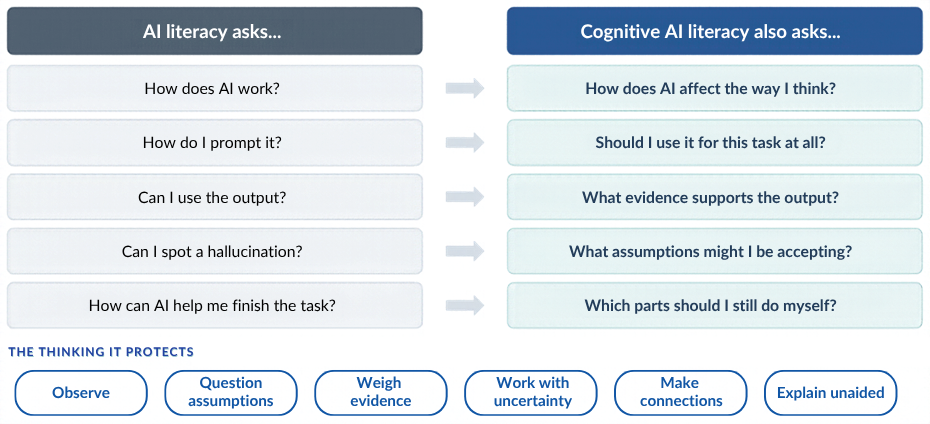
The value of effort depends on the lesson
Education has always used tools to make some tasks easier. Calculators, spellcheckers and search engines reduce the time spent on particular operations. Whether that helps depends on what the student is meant to learn. The question is not whether a tool removes effort, but which effort it removes.
A calculator may let an older student concentrate on statistical interpretation, while an early mathematics lesson may require pupils to practise number operations themselves. Automatic transcription could help a student focus on analysing an interview, while a writing exercise may depend on the student composing and revising sentences. Formatting, sorting information and routine calculation are often reasonable candidates for assistance. Working through a hard problem, constructing an argument, interpreting evidence and reflecting on why an error occurred generally need more deliberate protection.
Teachers can make that distinction explicit when setting tasks. They can identify the thinking students are expected to practise, decide when assistance is appropriate and explain what independent work will be required. The same AI tool may be suitable in one lesson and counterproductive in another.
Scaffolding, not substitution
Consider a student stuck on a multi-step algebra problem. In one version, they paste the problem into an AI tool, receive a full worked solution and copy it. The task is complete, but the student’s reasoning has been bypassed, and the finished exercise gives the teacher little evidence of understanding. That is AI as substitution.
In another version, the student first attempts the problem, asks the tool to check a particular step and receives a hint rather than an answer. They find the error, revise their working and explain the method. That is AI as scaffolding: the technology removes unnecessary friction while the reasoning stays with the learner.
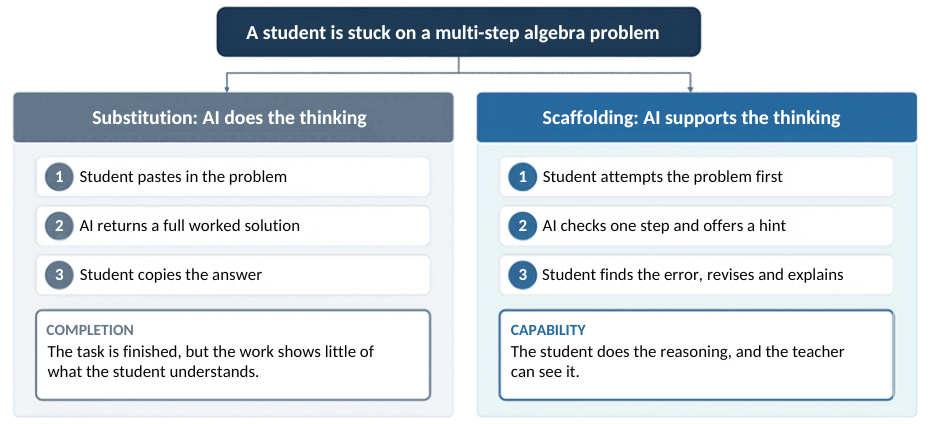
Figure 2. The same tool can lead to completion or to capability. The difference is who does the reasoning.
The educational question is not whether AI is used, but whether its use preserves the thinking through which learning happens.
Six habits of thinking worth protecting
Scaffolded use of AI tends to protect a small set of thinking habits that apply across subjects. Each gives teachers something concrete to design for.
- Observe before concluding. In science, students record what they see before asking AI to compare possible explanations. In mathematics, they identify what is known and unknown before asking for help.
- Question assumptions. Fluent language can hide what an answer takes for granted. Students should ask what would need to be true for it to be correct, and what might have been missed.
- Weigh evidence, not assertion. “The AI says so” is not the same as “the evidence supports it”. In history, students can examine a source before evaluating an AI-generated interpretation. In writing, they can build an argument first, then use feedback to test whether the evidence holds up.
- Work with uncertainty. A confident answer can contain an unsupported inference, overlook context or give an incomplete explanation. Students should be able to name alternative interpretations and say why they accept or reject a conclusion.
- Make connections. Understanding grows when students link ideas and apply them in unfamiliar contexts, rather than collecting isolated answers.
- Explain without assistance. The real test of AI-supported learning is not whether a student can produce a good answer with AI, but whether they can explain, question, apply and extend that answer without it.
A progression through K–12
Expectations should change with age and subject knowledge. Younger pupils need concrete ways to recognise that AI can be wrong. Older students can compare sources, evaluate uncertainty and defend their decisions. Each stage can be anchored in one question students learn to ask. The progression below illustrates how schools might put this into practice; it is not an official sequence from UNESCO or the OECD.
| School stage | Central question | Illustrative student activity | What the teacher looks for |
| Primary | Does this make sense? | Compare an AI-generated description with an object, image or observation made in class. | Can the pupil spot a mismatch and explain what they observed? |
| Lower secondary | How do I know? | Check an AI explanation against a textbook example, data set or primary source. | Can the student find supporting evidence, identify an error and explain the reasoning? |
| Upper secondary | What evidence supports this? | Evaluate competing explanations and decide whether AI assistance is appropriate for a task. | Can the student justify a conclusion, acknowledge uncertainty and work independently when required? |
| Pre-university | What should I conclude, and why? | Use AI as a research and problem-solving partner on an extended project. | Does the student keep responsibility for interpretation, evidence and conclusions? |
Assessment needs evidence of thinking
AI-generated work can make a finished assignment look more polished than the learning behind it. A teacher who sees only the final response may miss the route a student took, including errors that reveal what needs to be taught next. As the product tells teachers less, evidence of thinking matters more.
Two students may earn the same mark for different reasons. One may know a procedure but struggle to use it on an unfamiliar problem. Another may choose a sound method and make a calculation error. The score matters, but it is not the whole learning story. Looking at workings, explanations and revisions helps a teacher tell these cases apart and choose a more useful response.
A score aggregates performance; learning is multidimensional. Student responses can carry signals of recall, understanding, application, reasoning, problem solving, transfer and connection-making. Treated as prompts for teacher investigation rather than fixed labels, these signals change the question from “Who scored higher?” to “What did each student demonstrate, and what should we help them develop next?”
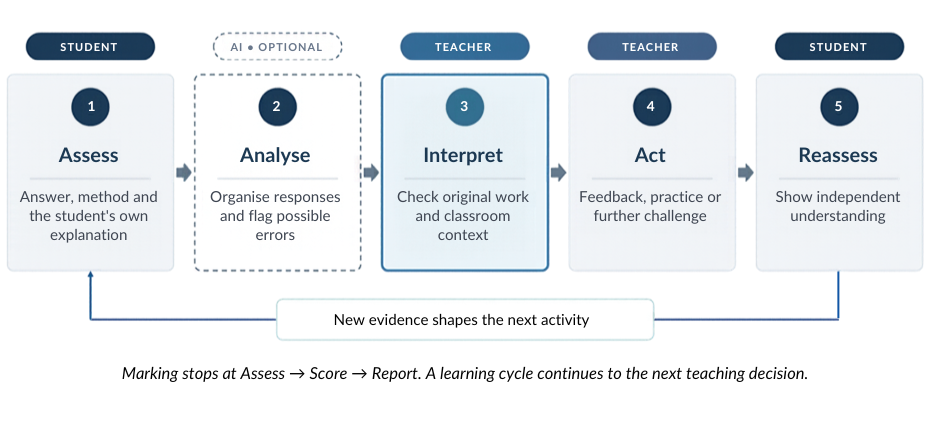
Figure 3. An illustrative assessment cycle. AI can help organise responses; the teacher interprets the evidence and decides what happens next.
AI-supported analysis can make this practical across a whole class set by organising responses, locating recurring errors or suggesting follow-up questions. Those outputs are provisional. A written answer may not show all the thinking that occurred, a short response can be ambiguous, and an apparent misconception may have several explanations. Teachers need to check the original work and consider what they know about the pupil before deciding on an intervention.
This is the difference between assessment automation and assessment intelligence. Automation marks answers, produces scores and ends with a report. A more useful cycle runs assess, analyse, interpret, act and reassess, with each round of evidence feeding the next activity. The aim is not to replace assessment with AI, but to make assessment more useful for learning, provided the analysis is accurate enough for its intended use and teachers keep control of the decision.
The teacher decides where assistance belongs
Teachers know the lesson sequence, the pupil’s earlier work and the conditions in which a response was produced. They recognise when a small error reveals a deeper misconception, and when a student needs challenge rather than remediation. AI can organise information, surface patterns and draft feedback. Deciding what matters, validating conclusions and choosing the intervention remain the teacher’s job. UNESCO’s AI Competency Framework for Teachers recognises this teacher–AI–student relationship and places human agency and AI pedagogy among the competencies educators need. Human validation is therefore not a failure of AI; it is part of good educational design.
Teachers do not need to become AI engineers, but they increasingly act as designers of human–AI learning interactions. For any activity, a few questions help:
- Should students use AI before or after attempting the task?
- Should the tool give an answer, a hint or a question?
- Which part of the activity must students experience for themselves?
- How will I know whether a student understands an AI-generated explanation, and can they reproduce the reasoning unaided?
- When should AI be left out of the task altogether?
A short explanation in the student’s own words, an unaided follow-up problem or a discussion of an error may reveal more about learning than a polished submission. In some assessments, AI use may need to be excluded so that independent performance can be evaluated.
What school leaders need to decide
School leaders set the conditions that make this possible. Five decisions matter most:
- What AI should do. Identify routine and administrative work that can safely be reduced, for staff and for students.
- What students must keep practising. Protect the activities through which reasoning, understanding, creativity and judgment develop.
- Where assistance stops. Define acceptable uses by age group and assessment purpose, including boundaries for independent work and high-stakes decisions.
- How to tell whether AI is helping. Look beyond usage statistics to whether students are becoming more independent and performing better on later, unaided tasks.
- What evidence to collect, and how to protect it. Gather evidence of learning processes, not just finished outputs. Set safeguards for pupil data and fairness, and support teachers in reviewing AI-generated feedback.
The goal is not less AI, but better-designed AI
AI will keep becoming more capable, and students will have access to systems that explain, generate, translate, solve and simulate. Trying to preserve every traditional form of effort is neither realistic nor desirable. But education evolving should not mean outsourcing every difficult cognitive task to a machine.
That gives schools a practical test. Decide what students should be able to do independently, design AI-supported activity around that requirement, and check whether the capability is developing. When students can explain their reasoning, challenge a generated answer and use what they have learnt on a new task, AI has left room for learning.
Let AI make learning easier where it should. Let students do the thinking they need to learn. And let teachers remain responsible for knowing the difference.
Recent Blogs

When to Let AI In: A Cognitive Guide for Researchers

From Content to Capability. A Playbook for Educational Content Producers in the AI Era.