
Beyond the AI Policy: What Publishers Need to Put AI into Practice

Integra Editorial Author

Across scholarly publishing, AI has entered day-to-day work faster than the structures needed to govern its use. Staff in editorial offices, research integrity teams, and marketing departments already rely on AI, as do the authors and reviewers with whom publishers work. The harder question is no longer whether to use AI, but how to integrate it into workflows without compromising confidential information, editorial independence, or accountability.
A recent Scholarly Kitchen article by Integra’s Ashutosh Ghildiyal and Gregory Simmons, “From AI Adoption to AI Practice,” explored this question, drawing on a presentation Simmons delivered to SSP’s AI in Scholarly Publishing Community of Interest. This post draws out key implications of that article alongside guidance from COPE, ICMJE, and STM, as well as recent discussions of human judgment.
Most are using AI; few feel ready
According to SSP’s AI in Scholarly Publishing Pulse Check, the vast majority of respondents reported at least one active AI use case in their organizations. Asked how prepared their organization was, only 3% said fully prepared.
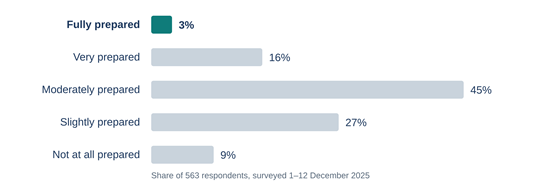
Figure 1. Only 3% of respondents rate their organization as fully prepared for AI. Survey conducted 1–12 December 2025; report published January 2026. Source: SSP Pulse Check.
The obstacles respondents named were ethical or legal concerns (63%), data privacy or security (61%), and a lack of expertise or staff capacity (50%). None of these challenges can be addressed simply by acquiring a better tool. For publishers they carry particular weight: unpublished work passes through many hands, and the publisher is answerable for what enters the scholarly record.
A rule is not a route
Guidance across the sector establishes several important principles. COPE holds that AI tools cannot be authors and that people remain accountable for their work. ICMJE’s guidance on reviewers’ AI use cautions against uploading manuscripts to AI tools “where confidentiality cannot be assured.” Separately, NIH prohibits generative AI in its own grant peer-review process. STM’s classification gives the industry a shared vocabulary for describing AI use.
Principles like these are necessary, but on their own they do not tell staff how to get the work done. Simmons made the point directly:
“A policy tells people what to avoid. On its own, it doesn’t help anyone finish their work.” — Gregory Simmons, in Ghildiyal and Simmons (2026)
Prohibiting the use of public chatbots for confidential manuscripts addresses one risk but can create another: staff facing deadlines without approved alternatives may turn to unsanctioned tools. One of the article’s practical takeaways states it directly: “Pair every restriction with a sanctioned alternative.”
| A RULE ON ITS OWN | A RULE WITH A ROUTE |
| Keep manuscripts out of public AI tools | …and here is the secure environment where you can do that task |
| Protect confidential information | …and here is what each approved system may and may not see |
| Use AI responsibly | …with these permissions, logged in this way |
| People remain accountable | …and this is who reviews and who decides, at each step |
Decide why before deciding what
The sequence matters as much as the rules. Simmons argues for settling purpose first, then strategy and controls, and choosing technology last: in his words, “with purpose, then strategy, governance, and technology, in that order.” A common failure is to reverse this sequence: an appealing tool is adopted first, and a use case is sought afterwards.
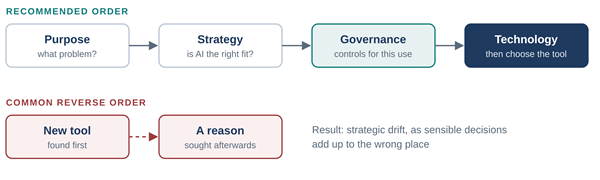
Figure 2. Choosing the tool last. Based on Simmons, in Ghildiyal and Simmons (2026).
This extends an argument made in “Before the Guardrails”: without a clearly defined purpose, individually reasonable decisions can collectively lead an organization in a direction it never deliberately chose.
Three things that have to work together
The article presents safe AI as the intersection of three elements. Each is necessary; none is enough alone.
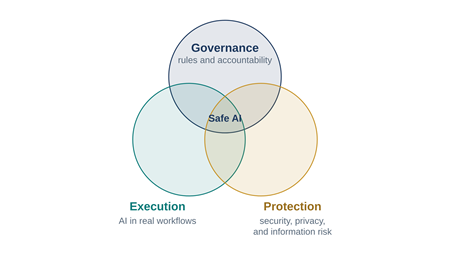
Figure 3. Safe AI as the overlap of governance, execution, and protection. Redrawn from Figure 1 in Ghildiyal and Simmons (2026).
| ELEMENT | QUESTION IT ANSWERS | WHAT IT LOOKS LIKE |
| Governance | Who sets the rules, and who answers for outcomes? | A list of approved systems, permissions, named owners, monitoring, and logs |
| Execution | Is AI actually helping in the work? | AI built into real tasks, with defined points where people check results |
| Protection | Is our information safe? | Limits on what each system can access, and on how its outputs are used |
In practice, this means building a governed environment rather than simply assembling a collection of tools. When employees independently select AI services, the organization may lack visibility into which tools are in use and what information is being shared with them. A managed environment that gives staff access to several models under shared controls can improve visibility and oversight, provided it is well configured, monitored, and governed; the platform alone does not do the governing.
Assist, review, decide
Simmons describes the underlying discipline as “appropriate automation”: deciding deliberately where automation adds value and where human judgment must remain central. One way to put this principle into operation is to classify each AI-supported step into one of three categories.
| AI ASSISTS | A PERSON REVIEWS | A NAMED PERSON DECIDES | |
| Meaning | AI performs or supports the task | Output is checked before anyone acts on it | An accountable owner makes the call |
| Typical examples | Summaries, classification, language help, pattern detection | Integrity flags, summaries of reports, reviewer suggestions | Publication decisions, ethics and misconduct outcomes |
| The article’s integrity example | A screening tool flags unusual citation patterns | An editor examines the flag in context | The editor decides what, if anything, to do |
A review step is only as good as the conditions around it. To be more than a rubber stamp, the person reviewing needs relevant expertise, access to the underlying evidence, the time and authority to challenge the AI output, and clear accountability for what follows.
Governance also cannot stop at the publisher’s own boundaries. It must account for the systems, partners, and external services through which confidential information moves, and for the responsibilities of authors, reviewers, and vendors as well as internal staff. This matters all the more because AI sits on both sides of the integrity problem. AI can facilitate the production of paper mill content, fabricated references, and manipulated images. It can also support screening systems designed to detect such problems, including tools available through the STM Integrity Hub.
| “The same technology creates some of these risks and helps manage them. Governance decides how it gets used.” — Gregory Simmons, in Ghildiyal and Simmons (2026) |
Ready is more than equipped
Having good controls is not the same as being ready. An organization can license capable AI and still lack the skills to use it, the clarity to govern it, or the habit of learning from what goes wrong. The conversation names six dimensions of readiness, and only one of them is about the technology itself.
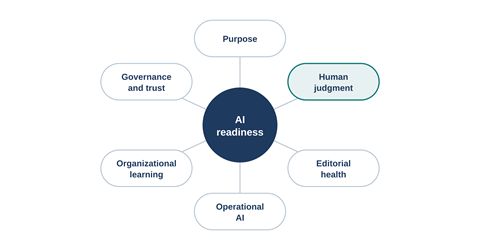
Figure 4. Six dimensions of AI readiness. Redrawn from Figure 2 in Ghildiyal and Simmons (2026).
AI literacy is part of readiness, and it has to go beyond knowing how to use a tool. It includes understanding a tool’s limitations, recognizing when its outputs can mislead, questioning its framing, and knowing when to rely on independent judgment instead. It must therefore include the ability to recognize when AI use may undermine independent thinking and professional judgment.
The judgment behind the safeguard
“A named person decides” is only a safeguard if that person can still judge well. Richard di Santo of JMIR Publications raised this point in the article’s comments, describing judgment as a skill that “erodes when it goes unused.” He develops the argument further in his guest post, “Freed from Thinking.” Rules can keep a human in the loop, but they cannot, by themselves, sustain that person’s capacity for independent judgment, particularly among early-career editors.
In Part 2 of “Reading Between the Lines,” building on the framework in Part 1, Ghildiyal explores this risk as cognitive debt: when people routinely encounter an AI interpretation before engaging with the underlying evidence, that interpretation can begin to frame their judgment. In “The Representation Is Not the Scholarship,” he further argues that AI can widen the gap between proxies, such as abstracts and metrics, and the underlying research, cautioning that “the representation is never the scholarship itself.” In his response to di Santo, Ghildiyal put it succinctly: “Judgment is born of attention and engagement.”
This makes the preservation of human judgment a governance responsibility in its own right. Organizations need to consider not only who makes a decision, but whether the people making it retain the expertise, independence, and confidence to do so.
Learn where mistakes are cheap
Editorial workflows receive much of the attention, but they are also among the highest-risk places to experiment. Tasks such as event preparation, marketing drafts, and internal knowledge searches often involve less sensitive information, though not always none. They can therefore be useful starting points for learning what AI does well and which controls matter.
| STARTING POINT | TYPICAL INFORMATION | SUGGESTED APPROACH |
| Marketing and events | Mostly public or internal | Early pilots; a person reviews anything published |
| Internal knowledge search | Internal documents | Inside an approved environment with access controls |
| Integrity screening | Unpublished manuscripts | Approved tools only; every flag checked by a person |
| Peer review and decisions | Manuscripts, reports, personal data | Tightest controls; AI assists, named people decide |
Integra’s illustration, ordered by the sensitivity of the information involved.
Our view: three things to get right
Reading this discussion alongside the wider guidance, three priorities stand out for publishers putting AI into practice.
Design the order of work, not just the rules. In editorial workflows, decide when AI output appears. Where feasible, presenting an AI assessment only after an editor has independently assessed the manuscript can help reduce anchoring and preserve independent judgment. This is a procedural safeguard that a policy alone cannot provide.
Treat partners and vendors as part of the system. Confidential material moves between publishers, service providers, reviewers, and tools. Ask every provider, including us, for evidence of performance, documented limitations, audit trails, and clear terms governing how submitted content is stored, processed, and used.
Measure decision quality, not only speed. Time saved is easy to count. What ultimately protects trust is whether decisions remain sound and whether staff retain the capacity to make them independently of AI.
Five steps to begin
1 Start with the work, not the tool. List the bottlenecks, repetitive tasks, and information-heavy processes where your teams lose time, and decide what improvement you are after.
2 Sort uses by how sensitive the information is. Public marketing copy and an unpublished manuscript need very different controls. Classify before you pilot.
3 Offer a sanctioned route for every rule. For each restriction, name the approved tool or environment people should use instead, and make sure authors, reviewers, editors, and vendors know the rules, not only staff.
4 Write down who reviews and who decides. For each AI-supported workflow, record where AI helps, which outputs a person must check, and who owns the decision, including steps run by partners.
5 Measure, learn, and adjust. Track a few indicators against a baseline, including the quality of decisions as well as speed, and revisit the controls as you learn.
Adapted from the practical takeaways in Ghildiyal and Simmons (2026).
The questions that will matter
As AI becomes ordinary, individual uses will stop standing out. What will distinguish publishers is whether they can say, at any moment, where AI is used, what it can see, which decisions it informs, and who is answerable for each. Those that can will be able to scale AI with confidence; those that cannot will find that trust, once lost, is slow to rebuild. Because the technology will keep changing, the approach has to be built to change too.
ABOUT THIS ARTICLE
Written by Integra Editorial. Integra provides AI-enabled publishing services; Ashutosh Ghildiyal (Vice President of Growth and Strategy) and Gregory Simmons (Vice President of Global Business Development) are Integra executives. Short quotations from The Scholarly Kitchen are marked and linked to their sources. AI tools assisted with research, drafting, and editing, and the text was reviewed by Integra Editorial before publication.
Recent Blogs

In the Age of AI, a Better Assessment Needs More Than a Better Question

From AI Governance to Human Agency: What Should Humans Remain Capable of Doing?