
Where Educational Value Moves in the Age of AI

Ashutosh Ghildiyal Vice President – Growth and Strategy

A strategic framework for education publishing and technology leaders navigating where value moves in the AI era.
Every major technological shift changes where value is created. Printing changed access. The internet changed distribution. Generative AI is changing the cost, speed, and scale at which information can be found, explained, adapted, and produced.
Digital libraries, open courseware, search, and open-access publishing had already made large bodies of information widely available before generative AI, though access was never universal and remains unequal today. Reliable knowledge still depends on evidence, expertise, context, language, accessibility, and trust.
Generative AI changes the question because it can now perform parts of the work between information and the learner. It can explain a concept at a chosen level, propose a sequence, generate practice, review a response, and return feedback within seconds. As information and some forms of learning support become more abundant, where should educational value concentrate?
A useful answer begins with the learner. Educational value includes the knowledge a learner acquires and the change produced through learning. A calculator performs arithmetic accurately, and children still learn arithmetic because the exercise develops understanding they will need later. The comparison is instructive in a second way. Calculators did change the curriculum. Log tables and slide rules left it, long division of large numbers lost emphasis, and estimation and number sense gained it. Some cognitive work was retired, some was kept, and the sorting was not obvious in advance.
AI reopens that sorting exercise across far more of the curriculum, and it will have to be settled subject by subject. The test is whether the learner is changed by doing the work or simply arrives at a result the machine could have produced. Exercises that pass that test earn their place. Exercises kept out of habit will not survive the scrutiny AI now invites. The same principle applies when a learner reads a difficult text, forms a position on contested evidence, or defends a conclusion under questioning. The resulting output matters, but so does the intellectual work through which it was produced.
Two Kinds of Cognitive Work
A useful way to think about this is to separate two kinds of cognitive work.
Mechanical cognition, in the terms used here, covers tasks that operate primarily on accumulated knowledge and recognizable patterns. Retrieval, comparison, classification, summarization, and some forms of analysis sit within this category. Current AI systems can perform a growing range of these tasks with considerable fluency.
Non-mechanical cognition describes discovery, discernment, and judgment developed through engagement with evidence, people, consequences, and uncertainty. This is a philosophical and strategic lens rather than a settled scientific taxonomy. The boundary will move as AI develops, and practitioners may disagree about where particular tasks belong.
This argument does not depend on drawing a permanent boundary around human capability. It asks what learners need to practice and develop for themselves, even when a machine can help produce the result. One form of learning consolidates established knowledge through instruction, practice, feedback, and reflection. Another tests and revises understanding when familiar explanations no longer fit what is observed. The latter is the process this lens calls discovery. Doing this work well depends on more than exposure to hard problems. Learners need scaffolding, feedback, and support to engage productively with real difficulty, not simply more of it. Without that support, the same problem that builds discernment in one learner can produce only frustration in another.
AI can support discovery. Whether an AI system can itself discover is a live question and not the one at issue here. The narrower point is that a learner does not acquire the capability by watching a system exercise it. A tool may surface competing interpretations or challenge an assumption. The learner still has to examine evidence, recognize what does not fit, and revise an understanding.
Discovery is what discernment builds on. A student conducting an experiment that contradicts expectations, a historian finding conflicting evidence, or an engineer discovering why a design fails all experience discovery before they exercise discernment. Applied to comprehension, discernment produces understanding. Applied to a decision made under uncertainty, discernment becomes judgment. In practice, these capacities appear when learners assess the credibility of sources, explain why one interpretation is stronger, transfer knowledge to a new setting, or consider the human consequences of a technically plausible decision. In product terms, offerings that help learners generate answers will grow increasingly commoditized, while offerings that help learners develop discernment will grow increasingly differentiated.
Schools, universities, and education companies have talked about holistic education, lifelong learning, and human potential for generations, long before anyone was talking about AI. AI brings a longstanding assessment problem into sharper view because a polished output may now reveal less about the learner’s independent understanding than it once did.
When Outputs No Longer Prove Learning
There is a real educational cost to getting this backwards. When learners repeatedly hand discovery and discernment to AI before they have done that work themselves, they accumulate what amounts to cognitive debt, a gradual erosion of exactly the capabilities education is meant to build, at least on a developmental account of its purpose. A learner who asks AI to resolve an argument before forming a view receives an answer while losing an opportunity to develop understanding.
That risk is not evenly distributed. Where someone learns to treat AI as a partner in discovery rather than a substitute for it, whether through a teacher, a mentor, a curious peer group, or their own habits of mind, AI use tends to build capability. Where that scaffolding is absent, AI use tends to erode it. The distribution of that scaffolding tracks existing inequality. The prior distribution of one-to-one support was itself deeply unequal, so a widely available assistant may narrow some gaps while widening others. Which effect dominates is a question of design and policy. not a property of the tool.
Cognitive debt should be treated as a design hypothesis rather than an established finding. A 2025 MIT Media Lab preprint reported lower neural connectivity, recall, and ownership among participants who used a large language model for an essay-writing task. The study involved 54 participants, addressed a narrow task, and was not peer reviewed at release. It offers an early signal rather than a general finding about learning with AI.
Evidence also runs in the other direction. A randomized study in a Harvard introductory physics course reported that students working with a purpose-built AI tutor learned more, and in less time, than students taught through active learning in class. A World Bank evaluation of an after-school AI tutoring program in Nigeria reported gains on measured outcomes for participating students.
A broader meta-analysis of 68 experimental and quasi-experimental studies found a moderate positive average effect of generative AI on learning outcomes, alongside substantial variation across studies. The authors found that educational level, subject area, intervention duration, and sample size were among the factors associated with differences in outcomes.
These findings also carry important limits, including differences in study duration, learner populations, subject areas, and implementation conditions, and they do not settle the broader question. Read alongside the preprint, they point to something more useful than a verdict on AI. Learning appears to improve when the tool is structured around a defined objective and the learner still has to do the work, and to suffer when the tool stands in for the work. The evidence suggests that outcomes depend substantially on how AI is used, the learning objective, the learner population, and the conditions in which the intervention takes place.
The same risk applies at the institutional level, and it is the one leadership teams are more likely to miss. An organization may improve the speed of content production, feedback, or administration while leaving the learning design unchanged. The result can be greater efficiency without stronger evidence of learner development. The response is deliberate design, observation, and adjustment, not a blanket restriction on AI use.
What Actually Changes
AI has made familiar outputs easier to produce, which places greater weight on trustworthy judgments about how they were produced and what the learner can do independently. Assessment practice is beginning to reflect this. Sector guidance points toward contextualized methods, authentic tasks, evidence of process, and appropriate checks of foundational knowledge. The balance will vary by discipline, learner group, risk, and institutional mission.
Recent evidence helps explain the urgency without settling the design question. HEPI’s 2026 survey of 1,054 UK undergraduates found that 94 percent used generative AI to help with assessed work. That figure establishes that adoption has happened rather than that learning has degraded, which is why the design question stands either way. TEQSA has called for assessment approaches that support trustworthy judgments about student learning, while the University of Sydney has separated secure assessments from open tasks in which AI may be used. These examples show active reconsideration rather than a single model for the sector.
That has real implications for curriculum, teaching, and assessment. Learners need sustained practice in inquiry, ethical reasoning, interpretation, and transfer. Assessment needs to consider the reasoning behind a conclusion and whether understanding can be applied in an unfamiliar setting. AI literacy needs to include decisions about when a tool is useful, when its output requires verification, and when independent work is essential.
It also raises the bar on measurement. Capabilities such as discernment and judgment rarely reduce to one score. Evidence may include the quality of questions a learner asks, the reasoning used to defend a position, the ability to transfer knowledge, and the care taken when evaluating an AI-generated response. Such evidence needs to be appropriate to the subject and usable by educators. These methods cost time that many institutions do not currently have, so sequencing matters. A realistic start is a small number of assessment points that carry the most weight rather than a wholesale redesign.
Where Educational Value Moves
Knowledge remains foundational. As generated material becomes easier to create, trustworthy knowledge infrastructure may become more valuable. Provenance, editorial judgment, accessibility, curriculum alignment, cultural and linguistic fit, structured metadata, and quality assurance remain demanding forms of work. Their value comes from reliability and use in context rather than volume alone.
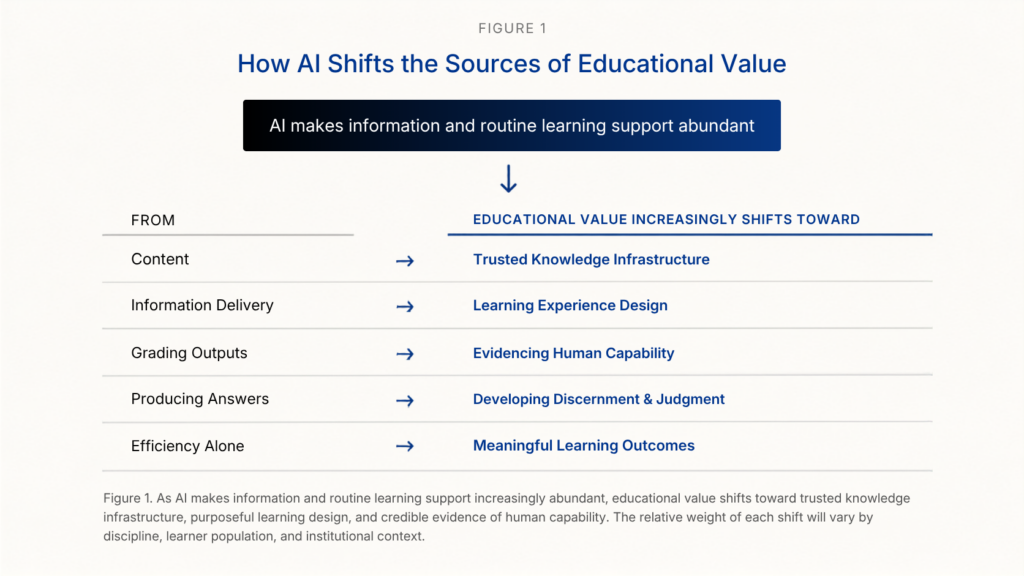
For education publishers and EdTech companies, the opportunity is to connect that foundation to purposeful learning experiences and credible evidence. Content can be structured so that concepts, learning objectives, activities, and assessments work together. Products can give learners repeated opportunities to inquire, apply, discuss, revise, and transfer. Assessment services can help educators combine authentic, open, and secure tasks in ways suited to the learning context.
Three shifts capture where this value moves, from content to trusted knowledge infrastructure, from information delivery to learning experience design, and from grading outputs to evidencing capability.
From content to trusted knowledge infrastructure. When anyone can generate plausible-sounding material in seconds, the scarce resource is material that can be trusted, meaning content with verified provenance, editorial judgment, curriculum alignment, and quality assurance built in from the start. Publishers who own that infrastructure own the foundation every AI-generated experience still has to stand on.
From information delivery to learning experience design. Delivering information is now commoditized; a chatbot can do it for free. The differentiated work is designing the sequence of inquiry, practice, feedback, and revision that turns information into capability. This is the kind of experience a learner cannot get from a general-purpose AI assistant working alone.
From grading outputs to evidencing capability. A single graded output no longer proves what a learner can do independently. Value shifts toward services and tools that generate credible, ongoing evidence of discernment and judgment, the kind of evidence that institutions, employers, and learners themselves can actually rely on.
Claims about capability require discipline. A simulation, AI tutor, or dashboard does not by itself demonstrate growth in judgment. A defensible claim needs a defined learner and context, a design that provides meaningful practice, evidence that educators can interpret, and evaluation over time. Learning analytics can support this work, provided that they measure more than activity and respect learner privacy.
Schools, colleges, and universities should not be treated as one market with one value model. Their missions, learners, disciplines, regulation, funding, and local conditions differ. Many are balancing AI adoption with teacher capacity, academic integrity, inclusion, infrastructure, student wellbeing, and financial pressure. Their value also includes public purpose, social mobility, belonging, and the credibility of qualifications.
Institutions often describe this same goal as academic rigor. Rigor here is not a matter of more work. It means higher expectations paired with the support that allows every learner to meet them. A product built only for mechanical efficiency can raise expectations without adding support, which widens gaps instead of than closing them. A product built around discovery, discernment, and judgment creates room to combine rigor with support, but only if publishers design for both together.
The Strategic Bottom Line
A product or portfolio review can begin with six questions.
- Which learner, educator, or institutional need does this offering address?
- What knowledge must remain structured, accessible, and understood by the learner?
- Where can AI improve access, feedback, practice, or efficiency without removing essential learning?
- What capability does the experience help learners practice, and what evidence would support that claim?
- How will educators exercise judgment over the design, its use, and its effect on different learners?
- Does this offering raise expectations without also raising the support available to meet them?
The central proposition is deliberately modest. As information and some forms of learning support become more abundant, educational value rests increasingly on trusted knowledge, purposeful learning design, and credible evidence of what learners understand and can do. The emphasis will differ across subjects, age groups, regions, and institutions. Those differences belong inside the strategy.
The future of education will not be determined by how much information AI systems can produce, but by how intentionally education develops the forms of human cognition that give knowledge meaning, judgment, and purpose. Organizations that support education can contribute by connecting reliable content, meaningful learning activity, and evidence while remaining attentive to educators, learners, and context. As AI lowers the cost of producing information, the competitive advantage in education moves toward developing human capability.
Recent Blogs

From AI Governance to Human Agency: What Should Humans Remain Capable of Doing?

Inside Integra’s Publisher Conversations at Frankfurt Book Fair 2026