
AI Was Built for Fluency. Science Was Built for Truth.

Ashutosh Ghildiyal Vice President – Growth and Strategy
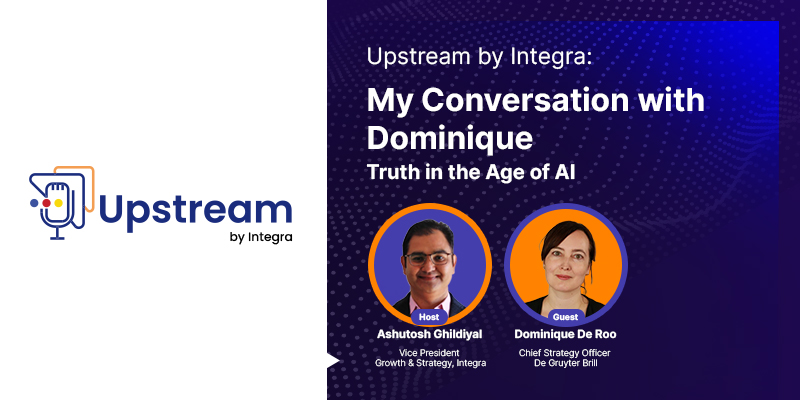
Every so often, a conversation changes the way I think about a familiar problem. My recent discussion with Dominique de Roo, Chief Strategy Officer at De Gruyter Brill, was one of those conversations.
We began by discussing artificial intelligence, expecting to explore productivity, automation, and publishing workflows. Instead, we found ourselves asking a much deeper question: what happens to scientific knowledge when AI becomes the primary interface between research and society?
The answer has implications not only for publishers, but for researchers, institutions, technology companies, and ultimately for public trust in science itself. That question has stayed with me long after our recording ended.
“AI changes how knowledge is accessed. It cannot replace the systems that make knowledge trustworthy.”
Dominique de Roo
Fluency Is Not the Same as Truth
One idea Dominique shared immediately stood out. Large language models are built to produce language that sounds natural and convincing. Their objective is fluency. They predict the next most probable word based on patterns in enormous datasets, which makes them remarkably effective at producing coherent responses.
Science operates on an entirely different principle. Scientific knowledge is not accepted because it sounds convincing. It earns credibility through a continuous process of validation. Peer review evaluates claims before publication. Replication tests whether findings hold up over time. Retractions correct the scholarly record when mistakes or misconduct come to light. Scientific progress depends on systems designed to question, challenge, and improve knowledge.
That distinction may seem subtle, but I believe it is becoming one of the defining conversations for our industry. Artificial intelligence is optimized to generate plausible answers. Scholarly publishing is optimized to establish trustworthy knowledge. Those are not the same objective.
| Large Language Models | Science and Scholarly Publishing |
| Optimized for fluency | Optimized for truth |
| Predicts the next probable token | Validates claims and hypotheses |
| Learns statistical patterns | Applies the scientific method |
| Generates plausible responses | Builds trustworthy knowledge |
| Confidence does not always equal correctness | Confidence follows evidence |
| Rarely self-corrects | Self-corrects continuously |
| Based on probability | Based on validation |
“Scientific publishing optimizes for truth. AI optimizes for plausibility.”
Are We Solving the Wrong AI Problem?
Most conversations about AI in scholarly publishing focus on what happens after an AI system produces an answer. We discuss attribution, citations, provenance, retrieval-augmented generation, and ways to make AI responses more transparent. These are all important discussions.
Dominique challenged me to think one step earlier. What happens before the answer is generated? How are these models trained, and what kinds of information enter those training datasets? Do the models distinguish between peer-reviewed research, preprints, blogs, retracted articles, and fabricated papers? Are they even capable of recognizing that not all knowledge carries the same level of credibility?
These questions receive far less attention than they deserve. If unreliable information becomes part of a model’s foundation, every downstream answer inherits that weakness. Improving citations after the fact cannot completely solve a problem that begins during training. This perspective shifts the conversation from AI interfaces to AI foundations.
| Current Industry Focus | Questions We Should Also Be Asking |
| Attribution | What data trains the model? |
| Citations | Does the model distinguish trustworthy sources? |
| Provenance | How are corrections incorporated? |
| Retrieval-augmented generation | Are retractions reflected? |
| Transparency | How should scientific quality influence training? |
| User interface design | What defines knowledge quality? |
“The real AI governance challenge begins long before an answer is generated.”
Publishers Become More Important, Not Less
It is tempting to assume that as AI increasingly mediates discovery, publishers become less relevant. I came away from our discussion with the opposite conclusion.
Historically, publishers have served two essential functions: disseminating knowledge and validating knowledge. Artificial intelligence is undoubtedly changing how research is discovered. Researchers are increasingly beginning literature searches through AI tools alongside traditional databases and search engines, and that trend is likely to accelerate.
But if AI increasingly handles discovery, the importance of validation only grows. Publishers remain the institutions responsible for maintaining the systems that establish scientific credibility. Peer review, editorial oversight, corrections, retractions, ethics policies, and research integrity processes are not peripheral activities. They are the mechanisms that transform information into trusted knowledge. In an AI-driven world, that responsibility becomes even more valuable.
| Traditional Publishing | AI Era Publishing |
| Disseminate knowledge | Ensure trusted knowledge reaches AI systems |
| Publish research | Validate research |
| Manage journals | Safeguard the scholarly record |
| Support researchers | Support researchers and AI ecosystems |
| Curate literature | Curate trustworthy knowledge |
“AI may mediate discovery, but publishers remain the custodians of scientific trust.”
Big Tech Is Now Part of the Scholarly Ecosystem
Publishers now have two audiences: human readers and machines. Metadata, persistent identifiers, corrections, retractions, licensing terms, and provenance are increasingly consumed not only by researchers, but also by AI systems. That changes the purpose of scholarly infrastructure itself. It is no longer simply supporting discovery. It is helping AI distinguish trustworthy knowledge from unreliable information.
Another realization from our discussion was that scholarly publishing has acquired a new stakeholder. For decades, publishers worked primarily with researchers, libraries, institutions, societies, and funders. Libraries in particular have long been, and remain, essential partners in this ecosystem. They curate collections, preserve the scholarly record, and guide researchers to trustworthy sources. Today, AI platforms have entered the picture as an additional participant, working alongside libraries and institutions rather than in place of them.
| Before AI: Researchers work with publishers, who work with libraries, institutions, and funders to disseminate and preserve knowledge. With AI in the picture: Researchers still work with publishers and libraries, who now also work alongside AI platforms and LLM providers to reach institutions, society, and funders. Libraries and institutions remain integral to the flow of trusted knowledge. AI platforms are a new channel alongside them, not a substitute for them. |
Large AI companies increasingly influence how scientific knowledge is discovered, interpreted, summarized, and presented to society. Whether we like it or not, Big Tech has become part of scholarly communication. That does not diminish the role of libraries or institutions. It means publishers, libraries, and institutions together must think about how trusted scientific knowledge flows into AI systems and how those systems represent that knowledge to millions of users.
“This is no longer simply a licensing conversation. It is becoming a governance conversation.”
AI Governance Begins Earlier Than We Think
Many current discussions around AI governance focus on transparency after an answer has been generated. Dominique encouraged a broader perspective: governance should begin before models are trained.
Imagine an AI model that understands the difference between a peer-reviewed article and an unreviewed manuscript. Imagine a model that recognizes when an article has been retracted or corrected. Imagine training processes that prioritize validated scientific knowledge instead of treating every document as equally valuable. These ideas move us toward what I would call knowledge-quality-aware AI.
| Training Question | Potential Publisher Contribution |
| Is the content peer reviewed? | Publisher metadata |
| Has the article been corrected? | Version of record tracking |
| Has it been retracted? | Retraction feeds |
| Is it a preprint? | Content labeling |
| Is it fabricated? | Integrity screening |
| Is it authoritative? | Editorial validation |
| Imagine AI systems that do not simply retrieve information, but understand its scientific status. A peer-reviewed article, a preprint, a corrected paper, and a retracted publication should not carry the same weight. Publishers already possess the metadata and editorial expertise to enable this distinction. |
The publishing industry possesses decades of expertise in evaluating evidence, documenting provenance, and maintaining the scholarly record. Those capabilities should not remain outside the AI ecosystem. They should become part of it.
Human Judgment Still Matters
One message remained consistent throughout our conversation: artificial intelligence should amplify human expertise, not replace it.
Researchers will continue using AI because it helps them work more efficiently. Editors will increasingly rely on AI-assisted workflows. Publishers will continue expanding integrity checks through automation. None of these developments eliminate the need for human judgment.
Peer review remains fundamentally human because it requires expertise, context, critical thinking, and intellectual curiosity. AI can support reviewers, but it cannot replace the scientific reasoning that experienced researchers bring to evaluating new knowledge. The same principle applies across scholarly publishing.
“Technology scales processes. People safeguard science.”
Collaboration Will Define the Next Chapter
One area where I found myself strongly agreeing with Dominique was the importance of collective action. No single publisher can solve AI governance. No single technology company can define trustworthy scientific knowledge. No individual stakeholder possesses all the expertise required.
Meaningful progress will require publishers, technology companies, researchers, libraries, societies, standards organizations such as Crossref, ORCID, STM, COPE, and NISO, and policymakers to work together. We have already seen this kind of collaboration succeed in areas such as persistent identifiers, metadata standards, open science, and research integrity. Artificial intelligence deserves the same collaborative mindset.
| AI Will Increase | Publishers Must Increase |
| Content generation | Validation |
| Research volume | Research integrity |
| Discovery speed | Trust |
| Automation | Human judgment |
| Knowledge accessibility | Scientific stewardship |
| AI adoption | Industry collaboration |
What This Means for Publishers
- Compete on trust, not speed.
- Influence AI training, not just AI outputs.
- Work with Big Tech, not only alongside it.
- Teach responsible AI use across the research ecosystem.
- Preserve human judgment while embracing AI productivity.
Looking Ahead with Optimism
Perhaps what impressed me most was Dominique’s optimism. It was not optimism about technology itself. It was optimism about the publishing community.
Scholarly publishing has spent decades adapting to digital transformation, open access, changing business models, evolving research practices, and increasing demands for transparency. Every period of disruption has required publishers to redefine how they create value. Artificial intelligence represents another transformation, but it does not diminish our purpose. If anything, it sharpens it.
As AI becomes increasingly fluent, the scientific community’s responsibility to preserve truth becomes even more important. That may ultimately be the most valuable contribution publishers make in the age of artificial intelligence, not simply helping information move faster, but helping society know what information deserves to be trusted.
Throughout our conversation, Dominique kept returning to a simple but profound idea. Publishers should not define their future by competing with AI. They should define it by strengthening the systems that AI itself depends upon. Scientific publishing has always been about far more than distributing content. It has been about creating confidence in knowledge.
AI may become the world’s most fluent communicator, but fluency is not truth. Truth still depends on the institutions willing to question, validate, correct, and preserve it. That responsibility belongs to all of us in scholarly publishing, and in the age of AI, it may be more important than ever.
The next chapter of scholarly publishing will not be defined by how quickly AI generates answers. It will be defined by whether the research community can ensure those answers remain anchored in evidence, provenance, and scientific accountability. In that future, publishers are not displaced by AI. They become even more essential to it.
“As AI becomes increasingly fluent, the responsibility to preserve scientific truth becomes even more important.”
About the Author
Ashutosh Ghildiyal is Vice President – Growth & Strategy at Integra, where he leads enterprise-wide initiatives spanning growth, strategy, marketing, innovation, and AI-driven solutions for scholarly publishing. With nearly 20 years of international leadership experience, he works at the intersection of scholarly publishing, artificial intelligence, and knowledge infrastructure. His interests include AI governance, research integrity, peer review, publishing innovation, and the future of human knowledge systems. Ashutosh hosts Upstream by Integra, a podcast featuring conversations with global leaders shaping the future of scholarly communication. He serves on the Board of Directors of the International Society of Managing and Technical Editors (ISMTE) and is a Chef at The Scholarly Kitchen, where he writes about scholarly communication, AI governance, research integrity, publishing strategy, and the future of knowledge.
Recent Blogs

From AI Governance to Human Agency: What Should Humans Remain Capable of Doing?

Inside Integra’s Publisher Conversations at Frankfurt Book Fair 2026