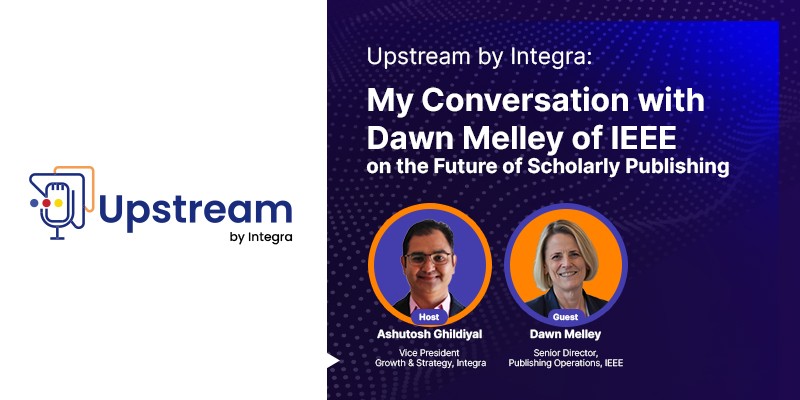
Upstream by Integra: My Conversation with Dawn Melley of IEEE on the Future of Scholarly Publishing

Ashutosh Ghildiyal Vice President – Growth and Strategy
Why We Started Upstream by Integra
Scholarly publishing is experiencing one of the most significant periods of change in its history.
Artificial intelligence is transforming workflows. Research integrity concerns are becoming more sophisticated and more difficult to detect. Submission volumes continue to rise. New expectations around openness, transparency, speed, and accessibility are reshaping how publishers operate. At the same time, our industry is facing a fundamental question: how do we continue to demonstrate and strengthen the value of scholarly publishing in a rapidly evolving world?
These questions inspired us to launch Upstream by Integra, a new podcast dedicated to conversations with the leaders, innovators, and thinkers shaping the future of scholarly and educational publishing.
The name Upstream reflects a belief that I have held for some time: the future of publishing is not determined at the end of the workflow. It is shaped much earlier through the strategic decisions, technologies, partnerships, policies, and communities that influence how knowledge moves through the research ecosystem.
For our inaugural episode, I had the privilege of speaking with Dawn Melley, Senior Director of Publishing Operations at IEEE, the world’s largest technical professional society. Dawn oversees a publishing operation that spans more than 250 journals, over 2,000 conference proceedings annually, books, peer review systems, and the delivery of content through IEEE Xplore. Few people have a broader view of scholarly publishing at scale.
What followed was a thoughtful and wide-ranging conversation about the challenges facing our industry and the opportunities emerging from them.
An Industry at an Inflection Point
One of my biggest takeaways from the conversation was that many of the challenges we discuss today ultimately stem from a single reality: scale.
Across scholarly publishing, submission volumes continue to increase while editorial resources remain constrained. Publishers are being asked to process more content, maintain high standards of quality and integrity, improve author experiences, and move faster than ever before.
As Dawn explained, IEEE has experienced sustained submission growth in recent years while also seeing acceptance rates decline. The result is a growing need to identify the best submissions earlier in the process and ensure that editors and reviewers can focus their time where it matters most.
What struck me was that IEEE’s response is not simply about managing volume. It is about rethinking infrastructure.
From Workflows to Connected Publishing Ecosystems
One of the most fascinating parts of our discussion centered on IEEE’s Publishing Portal initiative.
Listening to Dawn describe the project, I was reminded that publishing is increasingly moving beyond individual workflows toward connected ecosystems.
Authors are often reviewers. Reviewers may become editors. Editors may also organize conferences. Researchers interact with publishers in multiple ways throughout their careers.
The Publishing Portal is designed around this reality, creating a more integrated experience across roles and touchpoints.
For me, this highlighted a broader shift taking place across scholarly publishing. Increasingly, success is not about optimizing individual processes. It is about creating connected systems that serve communities more effectively.
AI Is Changing the Conversation, Not Replacing People
No discussion about the future of publishing can avoid the topic of AI.
What I appreciated about Dawn’s perspective was its balance.
She acknowledged that AI is contributing to some of the challenges publishers face today. The technology has lowered barriers to content creation and introduced new concerns around research integrity, authorship, and peer review.
At the same time, AI is becoming an important tool for addressing those very challenges.
At IEEE, AI is being explored to support manuscript screening, scope assessment, reference validation, integrity checks, peer review workflows, and open science initiatives.
Yet one message came through clearly throughout our discussion: human expertise remains indispensable.
As AI becomes more deeply embedded in publishing workflows, editorial judgment, subject expertise, and accountability become even more important. The future is not about replacing people with technology. It is about helping people make better decisions with better tools.
Rethinking Research Integrity in the Age of AI
Research integrity was another central theme of our conversation.
The scholarly publishing community is facing increasingly sophisticated forms of misconduct, ranging from paper mills and identity fraud to manipulated peer review and AI-assisted deception.
What I found particularly interesting was Dawn’s emphasis on trust and accountability.
Rather than focusing solely on detecting AI-generated content, she suggested that the industry may need to focus more on establishing confidence in the people behind submissions. In other words, the question is becoming less about whether AI was used and more about whether there is a responsible and accountable researcher standing behind the work.
This shift toward trust markers, identity verification, and accountability could become one of the most important developments in scholarly publishing over the next several years.
The People Behind the Publishing Process
Technology featured prominently throughout our discussion, but so did people.
Dawn spoke passionately about IEEE’s volunteer community, including editors, reviewers, and society leaders who contribute their time and expertise to advancing research and scholarship.
One observation particularly resonated with me. Dawn noted that, in many ways, the volunteers motivate the publishing staff more than the other way around.
That comment serves as an important reminder that scholarly publishing remains fundamentally a human endeavor. Behind every manuscript, journal, conference, and research breakthrough are people committed to advancing knowledge and serving their communities.
As our industry embraces new technologies and new ways of working, preserving and supporting that human foundation remains essential.
Why Collaboration Has Never Been More Important
The conversation concluded with a topic that I believe will define the next chapter of scholarly publishing: collaboration.
Whether the challenge is research integrity, AI governance, identity verification, infrastructure development, or policy engagement, no single organization can solve these issues alone.
Dawn highlighted the growing role of organizations such as STM, CHORUS, COPE, SSP, and ALPSP in bringing stakeholders together. She also pointed to initiatives such as the STM Integrity Hub as examples of the kind of collective action that is increasingly needed across the industry.
I left the conversation feeling optimistic. While the challenges facing scholarly publishing are significant, there is also a growing willingness among publishers, societies, institutions, technology providers, and other stakeholders to work together in ways that were far less common a decade ago.
Looking Ahead
As I asked Dawn my final question, I invited her to imagine where scholarly publishing might be five years from now.
Her answer was refreshingly grounded. Rather than making bold predictions, she spoke about the importance of strengthening collaboration, maintaining trust, and doubling down on the core value that publishers bring to the research ecosystem.
That perspective perfectly captured the spirit of our conversation.
If there was one message I took away from this inaugural episode of Upstream by Integra, it is this: the future of scholarly publishing will not be shaped by technology alone. It will be shaped by how effectively we combine technology with human expertise, community engagement, integrity, and collaboration.
Those are the conversations we hope to continue through this podcast, and I could not have asked for a better guest to help launch that journey.
Listen to the Episode
Listen to Episode 1, Leading at Scale with Dawn Melley of IEEE , on the Upstream by Integra podcast page or on your preferred podcast platform.
Podcast Page
Spotify
Apple Podcasts
YouTube
A Note of Thanks
My sincere thanks to Dawn Melley for being the inaugural guest on Upstream by Integra and for sharing her experience, insights, and thoughtful perspective on the future of scholarly publishing.
I would also like to thank IEEE for its continued leadership in advancing science, technology, and scholarly communication around the world. The organization’s commitment to quality, innovation, research integrity, and community engagement was evident throughout our discussion.
We are grateful for the opportunity to begin this journey with such an accomplished guest and look forward to bringing many more voices from across the scholarly publishing ecosystem to future episodes of Upstream by Integra
About the Author
Ashutosh Ghildiyal is Vice President – Growth & Strategy at Integra, where he leads enterprise-wide initiatives spanning growth, strategy, marketing, innovation, and AI-driven solutions for scholarly publishing. With nearly 20 years of international leadership experience, he works at the intersection of scholarly publishing, artificial intelligence, and knowledge infrastructure. His interests include AI governance, research integrity, peer review, publishing innovation, and the future of human knowledge systems. Ashutosh hosts Upstream by Integra, a podcast featuring conversations with global leaders shaping the future of scholarly communication. He serves on the Board of Directors of the International Society of Managing and Technical Editors (ISMTE) and is a Chef at The Scholarly Kitchen, where he writes about scholarly communication, AI governance, research integrity, publishing strategy, and the future of knowledge.
Recent Blogs
From AI Governance to Human Agency: What Should Humans Remain Capable of Doing?

Inside Integra’s Publisher Conversations at Frankfurt Book Fair 2026