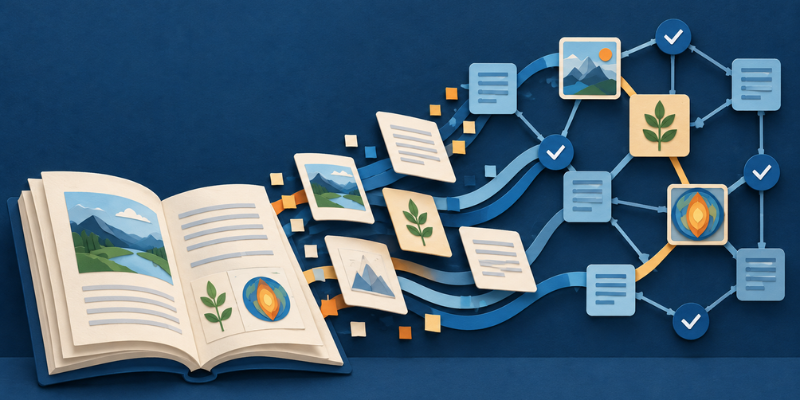
Reflections from SSP 2026: Trust, Transformation, and the Future of Scholarly Publishing

Ashutosh Ghildiyal Vice President – Growth and Strategy
The Society for Scholarly Publishing (SSP) Annual Meeting has always been one of the most important gatherings in scholarly communication. It brings together publishers, societies, researchers, librarians, technology providers, and service partners to exchange ideas, challenge assumptions, and collectively reflect on the future of our industry.
This year’s meeting in Chula Vista, California, arrived at a particularly interesting moment.
Scholarly publishing is navigating a period of significant change. Artificial intelligence is reshaping workflows and discovery. Research integrity concerns continue to evolve. Funding pressures are affecting institutions and researchers. Submission volumes continue to grow. Open Access models remain in transition. Meanwhile, geopolitical developments and shifting research policies are influencing global publishing patterns in ways that are still unfolding.
Against this backdrop, SSP 2026 provided an opportunity for the community to take stock of where we are, where we may be headed, and what challenges and opportunities lie ahead.
While there was no single dominant topic that defined the meeting, one idea surfaced repeatedly across sessions, hallway conversations, and one-on-one meetings:
How do we adapt and innovate in turbulent times while staying true to the mission of integrity at the heart of scholarly communication?
That question captured much of the mood and substance of SSP 2026.
An Industry in Transition
Walking through the halls of SSP, one could sense both uncertainty and momentum.
The scholarly publishing industry faces no shortage of challenges. Research funding is under pressure in many regions. Library budgets remain constrained. Peer review systems continue to experience growing strain. Artificial intelligence is introducing both opportunities and risks. At the same time, publishers are grappling with changing author expectations, evolving business models, and increasing demands for transparency and accountability.
The mood of the meeting reflected an industry in transition.
Research output and submissions continue to grow, but there is also real caution in the air. Conversations touched on a more challenging employment market, slower hiring across parts of the industry, policy uncertainty, and unresolved questions about AI’s long-term impact. Depending on who you spoke with, predictions about the future varied considerably.
What stood out, however, was not disagreement. It was the absence of certainty.
No one appeared to have a definitive roadmap for what scholarly publishing will look like five years from now. Yet there was a widespread willingness to learn, experiment, and adapt together. In many ways, that may be more valuable than certainty itself.
The conversations were practical rather than ideological. People were less interested in debating whether change is coming and more interested in understanding how best to navigate it.
Navigating the Paradox
A recurring idea throughout the meeting was the notion of a paradox.
On one hand, publishers are being asked to innovate faster than ever before. New technologies, changing researcher behaviors, evolving business models, and increasing competition are driving transformation across the industry.
On the other hand, the core responsibilities of scholarly publishing remain unchanged.
Research must be evaluated rigorously. Findings must be communicated accurately. The scholarly record must be preserved and protected. Trust must be maintained.
The challenge is not choosing between innovation and integrity.
It is finding ways to advance both simultaneously.
Many of the most thoughtful discussions at SSP focused on this balance. How can organizations embrace new technologies while safeguarding quality? How can workflows become more efficient without compromising rigor? How can innovation strengthen trust rather than undermine it?
These are not easy questions, but they are increasingly becoming defining questions for the industry.
AI Is Reorganizing the Scholarly Communication Ecosystem
As expected, artificial intelligence featured prominently throughout the meeting.
What was striking, however, was how much the conversation has matured over the past year.
The discussion is no longer centered on whether AI will impact scholarly publishing. That question has largely been answered. AI is already influencing manuscript preparation, editorial workflows, peer review support, content screening, discovery, and research processes.
Instead, the conversation has shifted toward understanding how AI will reorganize the broader scholarly communication ecosystem.
The thread running through many AI discussions was not really about AI itself. It was about how the scholarly communication ecosystem is being reorganized.
Journals are not becoming less important.
Scholarly content is not becoming less important.
Their role is evolving.
AI may increasingly become the primary interface through which knowledge is discovered and consumed. Researchers may interact less with traditional search platforms and more with intelligent systems capable of summarizing, synthesizing, contextualizing, and connecting information from across the scholarly record.
If that happens, the value of publishers may increasingly lie beneath the interface.
AI systems require trusted inputs. They require validated research. They require structured metadata, provenance information, editorial oversight, and mechanisms for verification.
In that environment, the role of publishers as stewards of trust may become even more important.
The question is not whether AI replaces publishers.
The more important question is whether publishers, researchers, institutions, and technology providers can adapt to a world in which trust, context, verification, and provenance become just as valuable as the content itself.
Trust and Research Integrity Continue to Rise in Importance
Closely connected to discussions about AI was the growing focus on trust.
Research integrity, transparency, metadata quality, persistent identifiers, publication ethics, verification, and provenance surfaced repeatedly throughout the conference.
These topics have been gaining attention for several years, but SSP 2026 suggested they are increasingly moving from operational concerns to strategic priorities.
The reason is straightforward.
As information becomes easier to generate and distribute, trust becomes more valuable.
Publishers are increasingly being recognized not only for their role in disseminating research but also for their role in validating it.
This shift is significant.
For decades, scholarly publishing has often been viewed primarily as a content distribution system. Increasingly, however, the industry’s value proposition is expanding to include trust, stewardship, and verification.
Editorial oversight, peer review, publication ethics, metadata standards, and research integrity processes are no longer simply workflow activities. They are becoming central components of how trust is established and maintained within scholarly communication.
For organizations working in editorial support, peer review management, and research integrity services, this evolution is particularly important. Maintaining trust in the scholarly record requires continuous investment in both expertise and technology.
The Growing Influence of China
One of the more substantive discussions at SSP focused on the continued growth of research output from China and its implications for the global publishing ecosystem.
China has become one of the world’s largest contributors to scholarly research. As a result, publishing trends, policy decisions, and author behaviors in China increasingly have the potential to influence the broader industry.
Several presentations highlighted both the scale of China’s research growth and the strategic implications for publishers worldwide.
Many publishers have invested heavily in author engagement, partnerships, educational programs, and long-term relationship building in China. At the same time, there is growing discussion around policies intended to strengthen domestic publishing ecosystems and encourage publication in local journals.
Even relatively small shifts in publishing behavior could have significant consequences for global publishing.
The discussions served as a reminder that scholarly publishing is increasingly shaped by global research dynamics. Strategic decisions can no longer be viewed through a purely regional lens.
The future of scholarly communication will almost certainly be more international, more multilingual, and more interconnected than it is today.
Looking for Signals, Not Certainty
One of the most interesting observations from SSP was that many participants were not searching for definitive answers.
They were searching for signals.
Across sessions and informal conversations, similar questions surfaced repeatedly:
– How will AI affect discovery and readership?
– What will sustainable Open Access models look like?
– How will research assessment evolve?
– What role will publishers play in five years?
– How will society publishers adapt?
– How will trust be established and communicated in AI-enabled environments?
There was little consensus on the answers.
What did emerge, however, was a collective effort to understand the direction of travel.
Organizations across the industry are experimenting, learning, and preparing for multiple possible futures rather than betting on a single outcome.
That willingness to engage constructively with uncertainty may ultimately prove to be one of the industry’s greatest strengths.
Community Remains SSP’s Greatest Strength
For all the discussion about technology and transformation, one of the most valuable aspects of SSP remains the community itself.
I intentionally spent much of my time in one-on-one meetings. That meant missing some sessions, and I have no regrets.
Reconnecting with colleagues and meeting people I had wanted to see for a long time made the trip worthwhile on its own. Some of the most valuable conversations happened not in meeting rooms but over coffee, during receptions, and in spontaneous discussions throughout the conference.
I was also fortunate to spend time with my fellow Scholarly Kitchen Chefs, whose warmth, generosity, and camaraderie made the experience even more memorable.
What strikes me about SSP every year is the strength of its community.
The visible appreciation for volunteers and the people working behind the scenes is a reminder that SSP is more than a conference. It is a community built on participation, collaboration, and a shared commitment to advancing scholarly communication.
In times of rapid change, communities become a form of infrastructure. They provide opportunities to exchange perspectives, share experiences, challenge assumptions, and collectively make sense of emerging challenges.
That spirit was evident throughout SSP 2026.
Innovation Continues Despite Uncertainty
If there was one thing SSP demonstrated clearly, it is that innovation in scholarly publishing remains strong.
New technologies, workflow solutions, AI-powered applications, research integrity tools, and author-focused services were on display throughout the meeting. Organizations across the ecosystem are actively developing solutions designed to improve efficiency, strengthen trust, and enhance the research experience.
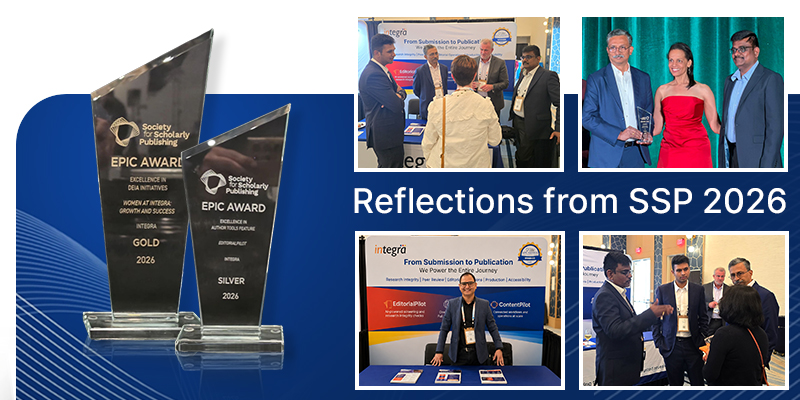
For Integra, it was particularly gratifying to see industry recognition through the SSP EPIC Awards.
EditorialPilot received a Silver Award in the Author Tools category, while the WInGS initiative received a Gold Award in the DEIA category.
These recognitions reflect the importance of both technological innovation and meaningful community impact.
More broadly, they serve as reminders that progress continues even amid uncertainty.
Looking Ahead
Leaving SSP 2026, the overwhelming impression was not one of disruption, but of momentum.
The industry faces important questions around AI, trust, research integrity, sustainability, funding, business models, and the future of scholarly communication. Many of those questions remain unanswered.
Yet there is a clear willingness across the community to engage with them openly and collaboratively.
Publishers, societies, technology providers, libraries, and service partners are experimenting, adapting, and learning together. The future may not look exactly like the past, but the mission that underpins scholarly publishing remains remarkably consistent: to advance, validate, and disseminate trusted knowledge.
That mission remains as important today as it has ever been.
If SSP 2026 demonstrated anything, it is that scholarly publishing continues to evolve while remaining grounded in the values that give it purpose. In an environment defined by rapid change, that combination of adaptability and commitment may be the industry’s greatest strength.
And that, more than any single technology, trend, or prediction, was the strongest signal to emerge from SSP 2026.
—
About the Author
Ashutosh Ghildiyal is Vice President – Growth & Strategy at Integra, where he leads enterprise-wide initiatives spanning growth, strategy, marketing, innovation, and AI-driven solutions for scholarly publishing. With nearly 20 years of international leadership experience, he works at the intersection of scholarly publishing, artificial intelligence, and knowledge infrastructure. His interests include AI governance, research integrity, peer review, publishing innovation, and the future of human knowledge systems. Ashutosh hosts Upstream by Integra, a podcast featuring conversations with global leaders shaping the future of scholarly communication. He serves on the Board of Directors of the International Society of Managing and Technical Editors (ISMTE) and is a Chef at The Scholarly Kitchen, where he writes about scholarly communication, AI governance, research integrity, publishing strategy, and the future of knowledge.
Recent Blogs


Where AI Ends and Editorial Judgment Begins: A Practical Map for the Journal Workflow