
Dominique de Roo of De Gruyter Brill on Truth in the Age of AI. Listen to Episode 2 of Upstream by Integra.

Listen Now

Where Educational Value Moves in the Age of AI

A strategic framework for education publishing and technology leaders navigating where value moves in the AI era.

Every major technological shift changes where value is created. Printing changed access. The internet changed distribution. Generative AI is changing the cost, speed, and scale at which information can be found, explained, adapted, and produced.

Digital libraries, open courseware, search, and open-access publishing had already made large bodies of information widely available before generative AI, though access was never universal and remains unequal today. Reliable knowledge still depends on evidence, expertise, context, language, accessibility, and trust.

Generative AI changes the question because it can now perform parts of the work between information and the learner. It can explain a concept at a chosen level, propose a sequence, generate practice, review a response, and return feedback within seconds. As information and some forms of learning support become more abundant, where should educational value concentrate?

A useful answer begins with the learner. Educational value includes the knowledge a learner acquires and the change produced through learning. A calculator performs arithmetic accurately, and children still learn arithmetic because the exercise develops understanding they will need later. The comparison is instructive in a second way. Calculators did change the curriculum. Log tables and slide rules left it, long division of large numbers lost emphasis, and estimation and number sense gained it. Some cognitive work was retired, some was kept, and the sorting was not obvious in advance.

AI reopens that sorting exercise across far more of the curriculum, and it will have to be settled subject by subject. The test is whether the learner is changed by doing the work or simply arrives at a result the machine could have produced. Exercises that pass that test earn their place. Exercises kept out of habit will not survive the scrutiny AI now invites. The same principle applies when a learner reads a difficult text, forms a position on contested evidence, or defends a conclusion under questioning. The resulting output matters, but so does the intellectual work through which it was produced.

Two Kinds of Cognitive Work

A useful way to think about this is to separate two kinds of cognitive work.

Mechanical cognition, in the terms used here, covers tasks that operate primarily on accumulated knowledge and recognizable patterns. Retrieval, comparison, classification, summarization, and some forms of analysis sit within this category. Current AI systems can perform a growing range of these tasks with considerable fluency.

Non-mechanical cognition describes discovery, discernment, and judgment developed through engagement with evidence, people, consequences, and uncertainty. This is a philosophical and strategic lens rather than a settled scientific taxonomy. The boundary will move as AI develops, and practitioners may disagree about where particular tasks belong.

This argument does not depend on drawing a permanent boundary around human capability. It asks what learners need to practice and develop for themselves, even when a machine can help produce the result. One form of learning consolidates established knowledge through instruction, practice, feedback, and reflection. Another tests and revises understanding when familiar explanations no longer fit what is observed. The latter is the process this lens calls discovery. Doing this work well depends on more than exposure to hard problems. Learners need scaffolding, feedback, and support to engage productively with real difficulty, not simply more of it. Without that support, the same problem that builds discernment in one learner can produce only frustration in another.

AI can support discovery. Whether an AI system can itself discover is a live question and not the one at issue here. The narrower point is that a learner does not acquire the capability by watching a system exercise it. A tool may surface competing interpretations or challenge an assumption. The learner still has to examine evidence, recognize what does not fit, and revise an understanding.

Discovery is what discernment builds on. A student conducting an experiment that contradicts expectations, a historian finding conflicting evidence, or an engineer discovering why a design fails all experience discovery before they exercise discernment. Applied to comprehension, discernment produces understanding. Applied to a decision made under uncertainty, discernment becomes judgment. In practice, these capacities appear when learners assess the credibility of sources, explain why one interpretation is stronger, transfer knowledge to a new setting, or consider the human consequences of a technically plausible decision. In product terms, offerings that help learners generate answers will grow increasingly commoditized, while offerings that help learners develop discernment will grow increasingly differentiated.

Schools, universities, and education companies have talked about holistic education, lifelong learning, and human potential for generations, long before anyone was talking about AI. AI brings a longstanding assessment problem into sharper view because a polished output may now reveal less about the learner’s independent understanding than it once did.

When Outputs No Longer Prove Learning

There is a real educational cost to getting this backwards. When learners repeatedly hand discovery and discernment to AI before they have done that work themselves, they accumulate what amounts to cognitive debt, a gradual erosion of exactly the capabilities education is meant to build, at least on a developmental account of its purpose. A learner who asks AI to resolve an argument before forming a view receives an answer while losing an opportunity to develop understanding.

That risk is not evenly distributed. Where someone learns to treat AI as a partner in discovery rather than a substitute for it, whether through a teacher, a mentor, a curious peer group, or their own habits of mind, AI use tends to build capability. Where that scaffolding is absent, AI use tends to erode it. The distribution of that scaffolding tracks existing inequality. The prior distribution of one-to-one support was itself deeply unequal, so a widely available assistant may narrow some gaps while widening others. Which effect dominates is a question of design and policy. not a property of the tool.

Cognitive debt should be treated as a design hypothesis rather than an established finding. A 2025 MIT Media Lab preprint reported lower neural connectivity, recall, and ownership among participants who used a large language model for an essay-writing task. The study involved 54 participants, addressed a narrow task, and was not peer reviewed at release. It offers an early signal rather than a general finding about learning with AI.

Evidence also runs in the other direction. A randomized study in a Harvard introductory physics course reported that students working with a purpose-built AI tutor learned more, and in less time, than students taught through active learning in class. A World Bank evaluation of an after-school AI tutoring program in Nigeria reported gains on measured outcomes for participating students.

A broader meta-analysis of 68 experimental and quasi-experimental studies found a moderate positive average effect of generative AI on learning outcomes, alongside substantial variation across studies. The authors found that educational level, subject area, intervention duration, and sample size were among the factors associated with differences in outcomes.

These findings also carry important limits, including differences in study duration, learner populations, subject areas, and implementation conditions, and they do not settle the broader question. Read alongside the preprint, they point to something more useful than a verdict on AI. Learning appears to improve when the tool is structured around a defined objective and the learner still has to do the work, and to suffer when the tool stands in for the work. The evidence suggests that outcomes depend substantially on how AI is used, the learning objective, the learner population, and the conditions in which the intervention takes place.

The same risk applies at the institutional level, and it is the one leadership teams are more likely to miss. An organization may improve the speed of content production, feedback, or administration while leaving the learning design unchanged. The result can be greater efficiency without stronger evidence of learner development. The response is deliberate design, observation, and adjustment, not a blanket restriction on AI use.

What Actually Changes

AI has made familiar outputs easier to produce, which places greater weight on trustworthy judgments about how they were produced and what the learner can do independently. Assessment practice is beginning to reflect this. Sector guidance points toward contextualized methods, authentic tasks, evidence of process, and appropriate checks of foundational knowledge. The balance will vary by discipline, learner group, risk, and institutional mission.

Recent evidence helps explain the urgency without settling the design question. HEPI’s 2026 survey of 1,054 UK undergraduates found that 94 percent used generative AI to help with assessed work. That figure establishes that adoption has happened rather than that learning has degraded, which is why the design question stands either way. TEQSA has called for assessment approaches that support trustworthy judgments about student learning, while the University of Sydney has separated secure assessments from open tasks in which AI may be used. These examples show active reconsideration rather than a single model for the sector.

That has real implications for curriculum, teaching, and assessment. Learners need sustained practice in inquiry, ethical reasoning, interpretation, and transfer. Assessment needs to consider the reasoning behind a conclusion and whether understanding can be applied in an unfamiliar setting. AI literacy needs to include decisions about when a tool is useful, when its output requires verification, and when independent work is essential.

It also raises the bar on measurement. Capabilities such as discernment and judgment rarely reduce to one score. Evidence may include the quality of questions a learner asks, the reasoning used to defend a position, the ability to transfer knowledge, and the care taken when evaluating an AI-generated response. Such evidence needs to be appropriate to the subject and usable by educators. These methods cost time that many institutions do not currently have, so sequencing matters. A realistic start is a small number of assessment points that carry the most weight rather than a wholesale redesign.

Where Educational Value Moves

Knowledge remains foundational. As generated material becomes easier to create, trustworthy knowledge infrastructure may become more valuable. Provenance, editorial judgment, accessibility, curriculum alignment, cultural and linguistic fit, structured metadata, and quality assurance remain demanding forms of work. Their value comes from reliability and use in context rather than volume alone.

For education publishers and EdTech companies, the opportunity is to connect that foundation to purposeful learning experiences and credible evidence. Content can be structured so that concepts, learning objectives, activities, and assessments work together. Products can give learners repeated opportunities to inquire, apply, discuss, revise, and transfer. Assessment services can help educators combine authentic, open, and secure tasks in ways suited to the learning context.

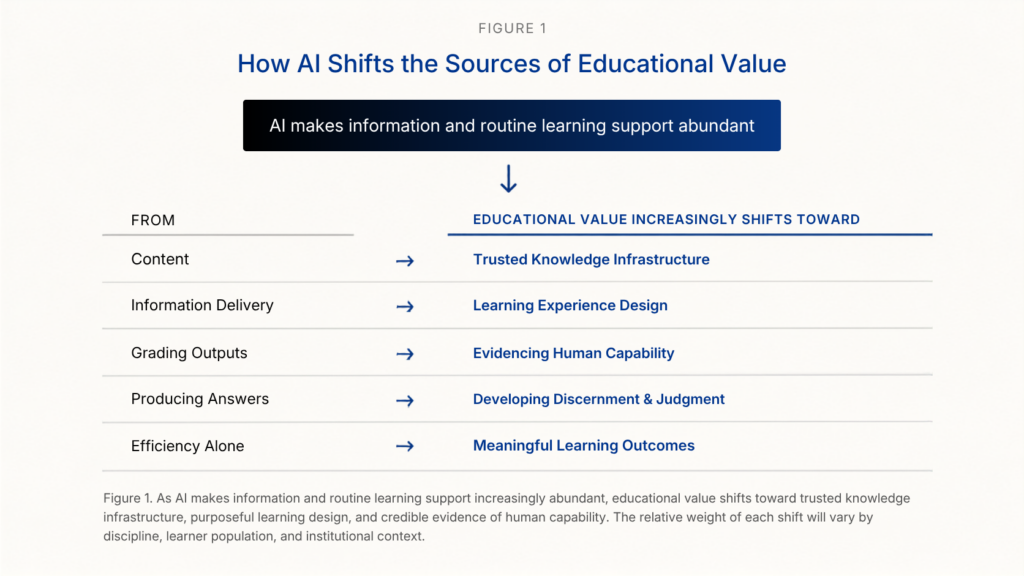
Three shifts capture where this value moves, from content to trusted knowledge infrastructure, from information delivery to learning experience design, and from grading outputs to evidencing capability.

From content to trusted knowledge infrastructure. When anyone can generate plausible-sounding material in seconds, the scarce resource is material that can be trusted, meaning content with verified provenance, editorial judgment, curriculum alignment, and quality assurance built in from the start. Publishers who own that infrastructure own the foundation every AI-generated experience still has to stand on.

From information delivery to learning experience design. Delivering information is now commoditized; a chatbot can do it for free. The differentiated work is designing the sequence of inquiry, practice, feedback, and revision that turns information into capability. This is the kind of experience a learner cannot get from a general-purpose AI assistant working alone.

From grading outputs to evidencing capability. A single graded output no longer proves what a learner can do independently. Value shifts toward services and tools that generate credible, ongoing evidence of discernment and judgment, the kind of evidence that institutions, employers, and learners themselves can actually rely on.

Claims about capability require discipline. A simulation, AI tutor, or dashboard does not by itself demonstrate growth in judgment. A defensible claim needs a defined learner and context, a design that provides meaningful practice, evidence that educators can interpret, and evaluation over time. Learning analytics can support this work, provided that they measure more than activity and respect learner privacy.

Schools, colleges, and universities should not be treated as one market with one value model. Their missions, learners, disciplines, regulation, funding, and local conditions differ. Many are balancing AI adoption with teacher capacity, academic integrity, inclusion, infrastructure, student wellbeing, and financial pressure. Their value also includes public purpose, social mobility, belonging, and the credibility of qualifications.

Institutions often describe this same goal as academic rigor. Rigor here is not a matter of more work. It means higher expectations paired with the support that allows every learner to meet them. A product built only for mechanical efficiency can raise expectations without adding support, which widens gaps instead of than closing them. A product built around discovery, discernment, and judgment creates room to combine rigor with support, but only if publishers design for both together.

The Strategic Bottom Line

A product or portfolio review can begin with six questions.

  • Which learner, educator, or institutional need does this offering address?
  • What knowledge must remain structured, accessible, and understood by the learner?
  • Where can AI improve access, feedback, practice, or efficiency without removing essential learning?
  • What capability does the experience help learners practice, and what evidence would support that claim?
  • How will educators exercise judgment over the design, its use, and its effect on different learners?
  • Does this offering raise expectations without also raising the support available to meet them?

The central proposition is deliberately modest. As information and some forms of learning support become more abundant, educational value rests increasingly on trusted knowledge, purposeful learning design, and credible evidence of what learners understand and can do. The emphasis will differ across subjects, age groups, regions, and institutions. Those differences belong inside the strategy.

The future of education will not be determined by how much information AI systems can produce, but by how intentionally education develops the forms of human cognition that give knowledge meaning, judgment, and purpose. Organizations that support education can contribute by connecting reliable content, meaningful learning activity, and evidence while remaining attentive to educators, learners, and context. As AI lowers the cost of producing information, the competitive advantage in education moves toward developing human capability.

AI in Education: 5 Trends Shaping Publishing, Assessment, and Platforms in 2026

A Shifting Landscape for Educational AI

As 2026 approaches, AI adoption in education appears to be moving into a more practical phase. For content, product, and technology leaders, the focus is shifting away from whether AI belongs in learning systems and toward how it may be designed, governed, and sustained at scale.

At the same time, long-standing boundaries between publishing, assessment, and platforms are beginning to blur. AI systems are increasingly positioned across these layers, making it more feasible for feedback, evaluation, and adaptation to occur closer to the learning experience itself rather than as a separate downstream process.

Across publishing, platforms, and instructional delivery, a consistent pattern is starting to take shape: AI systems tend to deliver more reliable results when they are built on clear structures, well-defined roles, and realistic expectations.

Below are five trends shaping how AI is likely to be applied in education over the coming year. Each reflects shifts already underway, framed for leaders responsible for publishing, assessment design, product development, and learning infrastructure.

1. Expert-Led Content Development Supported by AI Systems

Content creation workflows are becoming increasingly hybrid. AI tools are being used to support tagging, drafting, localization, and item generation, while content and editorial experts continue to own instructional quality, accuracy, and review.

What this looks like in practice:

  • AI-assisted generation of practice questions, summaries, and alternative explanations aligned to existing content.
  • Automated tagging and classification to reduce manual production effort.
  • Editorial review processes that validate AI-generated outputs before release.

Why it matters:
Treating AI as part of the production pipeline, rather than a shortcut, can help teams increase throughput without lowering standards. Organizations that define clear review and governance models are finding AI useful for scale, not substitution.

2. AI-Ready Content Architecture

AI systems increasingly sit on top of existing curriculum libraries. Whether they support personalization, retrieval, or generation, their effectiveness depends on how content is structured well before models are applied. Many organizations are discovering that while their materials are digital, they are not designed for machine use.

What this looks like in practice:

  • Curriculum audits focused on structure rather than pedagogy, identifying oversized lessons, unclear learning objectives, and missing metadata.
  • Rebuilding content at the concept or skill level so individual components can be retrieved, recombined, and sequenced with less manual intervention.
  • Expanding metadata beyond standards alignment to include prerequisites, cognitive demand, and instructional intent.

Why it matters:
AI systems do not interpret context the way humans do. When content is modular and well-tagged, AI tools can support personalization and adaptation with lower risk of distorting meaning. For many publishers and platforms, content architecture is emerging as both a constraint and an opportunity in AI adoption.

3. Multi-Modal Assessment and AI-Assisted Evaluation

As learning outputs diversify, assessment models are being pushed beyond essays and exams. AI tools are being applied to help evaluate presentations, projects, code, and collaborative work using more consistent criteria.

What this looks like in practice:

  • Shared rubrics applied across written, visual, oral, and interactive submissions.
  • AI-supported analysis of speech, images, code, and contribution logs.
  • Faster formative feedback, with educators retaining final judgment.

Why it matters:
Multi-modal assessment has long been limited by grading workload and consistency. AI can lower some of these barriers, but only when scoring logic is transparent and human review remains central. The goal is better alignment between instruction and evaluation, not automation for its own sake.

Why it matters:
Group learning is central to classroom instruction but difficult to observe consistently at scale. AI can provide additional visibility into participation and engagement, but only when educators retain control. The value lies in surfacing patterns, not directing social interaction.


Assessment-in-the-flow of Learning

4. Predictive Personalization and Early Support

Adaptive systems are moving beyond responding to performance after the fact. By analyzing learner behavior patterns, newer platforms aim to anticipate where students may struggle and surface support earlier in the learning process.

What this looks like in practice:

  • Signals based on response time, error patterns, and activity sequences rather than single assessment scores.
  • Proactive recommendations for review activities or alternative explanations.
  • Alerts that help teachers prioritize attention before learners fall behind.

Why it matters:
Predictive insights shift assessment data from reporting toward decision support. Used carefully, they can help educators intervene earlier. Used poorly, they risk overconfidence in probabilistic outputs. This distinction is becoming increasingly relevant for leaders evaluating these systems.

5. AI Support for Collaborative Learning

Most early AI tools in education were designed for individual use, such as tutoring, practice, or feedback. That focus is beginning to broaden. New tools are being introduced to support group-based learning by analyzing participation patterns and surfacing prompts during collaborative work.

What this looks like in practice:

  • Systems that monitor discussion flow and flag uneven participation or stalled progress during group activities.
  • AI-generated prompts or questions that teachers can choose to introduce during discussions or projects.
  • Dashboards that help educators see collaboration patterns across teams rather than focusing only on individual performance.

AI in Education: 2026 and Beyond

Across all five trends, a common theme stands out: progress depends less on new models and more on design discipline. Content structure, workflow clarity, and governance will influence whether AI tools remain experimental or become dependable parts of educational systems.

For leaders in product, technology, and content operations, 2026 is shaping up to be a period of consolidation, where expectations around AI become more grounded and more precise.


Whether you are updating existing materials or undertaking large-scale content transformation, Integra’s Content Engineering for AI team provides the bandwidth and expertise needed for modular design, metadata frameworks, and AI-ready content architecture. We can work alongside your teams to accelerate production and ensure consistency.

The Emergent Role of Artificial Intelligence (AI) in Fostering Collaborative Learning Experiences

Era of AI-Enhanced Collaborative Learning

Collaborative learning has consistently been a fundamental element in educational frameworks, advocating for the concept that interaction and teamwork greatly improve the learning experience. Traditionally, this concept has revolved around group activities, peer-to-peer interactions, and collective problem-solving tasks, fostering an environment where knowledge is not just consumed but dynamically created through social interaction. However, as we step into an era increasingly influenced by technological advancements, a new player enters the educational arena – Artificial Intelligence (AI).

The integration of AI into collaborative learning is not just a futuristic concept but a burgeoning reality, reshaping the very fabric of educational interactions. This article delves into the traditional models of collaborative learning, examines the transformative role of AI in these models, and explores the impact of this synergy on the educational landscape. We stand at the cusp of a new educational revolution, where AI not only complements but also enhances collaborative learning, paving the way for more personalized, efficient, and engaging educational experiences.

What is Collaborative Learning?

Collaborative learning, a pedagogical approach where individuals come together in a shared pursuit of educational objectives, has long been a staple in classrooms worldwide. Its roots can be traced back to ancient educational philosophies, where learning was considered a communal activity. Over time, this approach evolved, adapting to various educational theories and practices, yet consistently emphasizing the value of group-based learning processes.

Advantages:

  • Enhanced Critical Thinking: Collaborative settings often require students to analyze and synthesize information collectively, thereby sharpening their critical thinking skills.
  • Improved Communication Skills: Regular interactions among peers foster better communication and interpersonal skills.
  • Increased Engagement and Motivation: Working in groups can lead to higher levels of engagement and motivation due to the social aspect of learning.


Limitations:

  • Group Dynamics Issues: The success of collaborative learning heavily depends on effective group dynamics, which can sometimes be challenging to achieve.
  • Unequal Participation: There’s a risk of some members contributing more than others, leading to unequal learning experiences.
  • Assessment Complexities: Evaluating individual contributions in a group setting can be complex and sometimes unfair.


Real-World Examples

In practice, traditional collaborative learning has manifested in various forms:

  • Classroom Group Projects: Where students work together on a shared goal, be it a research project, a presentation, or a creative endeavor.
  • Study Circles: Small groups that meet regularly to discuss and learn about a specific subject matter.
  • Peer Tutoring Programs: Where students learn from and support each other under a structured program.


These examples highlight the versatility and adaptability of collaborative learning in fostering an interactive and inclusive educational environment.

Artificial Intelligence: A New Chapter in Education

The integration of Artificial Intelligence (AI) into the educational sphere marks a significant shift from traditional pedagogical approaches. AI in education transcends beyond mere technology use; it represents a paradigm shift where learning processes are becoming more adaptive, personalized, and efficient. This incorporation of AI is transforming the landscape of education, paving the way for innovative teaching methodologies and learning experiences that were once considered futuristic.

AI-Driven Tools and Platforms

AI-driven tools and platforms are increasingly becoming central to the educational experience. These include:

  • adaptive learning systems that tailor content to individual learner’s needs
  • AI tutors providing personalized assistance
  • data analytics tools that offer insights into student performance


Such tools not only streamline educational processes but also enhance the learning experience by making it more engaging and tailored to individual preferences and needs.

Impact on Educators and Learners

The advent of AI in education is reshaping the roles of educators and learners:

  • For Educators: AI tools are transitioning educators from information dispensers to facilitators of learning. They now have more resources to assist in creating a more interactive and personalized learning environment.
  • For Learners: Students are benefiting from AI through customized learning paths, immediate feedback, and a more engaging learning experience. AI empowers them to take charge of their learning journey, making it more aligned with their individual learning styles and pace.


AI’s integration into education is not just enhancing learning experiences but is also setting the stage for a future where education is more inclusive, effective, and aligned with the needs of the digital age.

Harnessing AI for Enhanced Collaborative Learning

Enhancing Interaction and Engagement

Artificial Intelligence (AI) is transforming collaborative learning, enabling more dynamic interaction and engagement among students.

  • Seamless Communication: AI-driven platforms facilitate smooth communication across different locations, ensuring effective idea and information exchange.
  • Catering to Diverse Learning Styles: AI tools adapt to various learning preferences, offering visual aids for visual learners and audio explanations for auditory learners.
  • Inclusive Learning Environment: This approach guarantees that every group member’s learning needs are met, making collaborative learning more inclusive and effective.


Personalization of Learning

AI’s capacity to tailor learning experiences individually is a pivotal advantage in collaborative learning settings.

  • Individualized Learning Analysis: AI algorithms analyze and adapt to each learner’s unique patterns, providing personalized content within a group environment.
  • Customized Support for Each Group Member: Every group member receives individualized guidance and resources, ensuring everyone is challenged and supported effectively.
  • Enhanced Group Learning Effectiveness: This customization enhances the overall learning experience, benefiting the group as a whole.


Data-Driven Insights

AI shines in offering insightful, data-driven feedback, essential in collaborative learning contexts.

  • Real-Time Feedback and Adaptation: AI tools analyze group interactions and performances, offering immediate feedback and adjusting learning materials to the group’s needs.
  • Enhanced Decision-Making in Group Learning: AI’s analysis can help identify focus areas for the group or suggest strategies to improve learning outcomes.
  • Alignment with Group Progress and Needs: The adaptive approach of AI ensures that learning materials are always relevant to the group’s current level and requirements.


AI in collaborative learning

Challenges and Ethical Considerations

Navigating Challenges

The integration of AI in collaborative learning, while transformative, is not without its challenges. A primary concern is the technological divide that may arise due to varying levels of access to AI technologies. This imbalance can result in uneven educational opportunities for students across the globe. Additionally, there is a significant need for adaptation and training for both educators and learners. Educators must be equipped to effectively incorporate AI tools into their teaching methodologies, and learners need guidance to navigate AI-enhanced learning environments.

Ethical Considerations

Ethical considerations are paramount when integrating AI into education:

  • Data Privacy and Security: As AI systems handle vast amounts of student data, ensuring the privacy and security of this data is crucial. Educational institutions must implement stringent measures to protect sensitive information.
  • Bias and Fairness: AI algorithms, like any technology, are susceptible to biases. It’s essential to continually assess AI tools for fairness and accuracy, ensuring that they do not perpetuate existing biases or create new ones. This involves a conscious effort in the design and implementation phases to make AI in education as equitable as possible.


Navigating New Frontiers in Collaborative Learning with AI

The integration of Artificial Intelligence (AI) into collaborative learning marks a significant advancement in education. Traditional models, though effective, have limitations that AI can overcome by enhancing interaction, personalizing experiences, and offering data-driven insights, thereby reshaping the educational landscape. However, this integration faces challenges such as the digital divide, the need for adaptation and training, data privacy concerns, and potential AI biases. These issues must be addressed to fully leverage AI’s potential in collaborative learning.

Looking ahead, AI’s role in education appears increasingly pivotal. Its ability to enhance traditional models, cater to diverse learning styles, and provide personalized experiences heralds a more inclusive, effective learning environment. The union of AI and collaborative learning transcends mere technological progress; it represents a stride towards a more connected, intelligent, and responsive educational system.

AI in Education: Reimagining the Role of Teachers

AI in Education

Artificial intelligence (AI) enabled tools are becoming mainstream in the education domain – with both teachers and students exploring its capabilities with equal interest. Most of the conversations have been around how students may tend to learn less by using AI tools that may result in superficial understanding of concepts without true comprehension or deeper knowledge retention. Of equal significance is also about teachers – exploring their evolving roles, how pedagogy will change, and how teachers will adapt in the classroom.

Shifting Roles of Teachers in the Age of AI

Technology adoption in the education domain has been a very slow and difficult process. It took many years to modernize education delivery – and for the better part of that period was devoted to leveraging technology on streamlining many administrative tasks. Education media on the other hand supplemented classroom sessions but teachers were central to the process of how students learned – specifically in the prek-12/school domain. Education has always been about two key participants – the teacher and the student.

AI’s disruptive role in the education value chain has necessitated critical review of the fundamental teacher-student dynamic. Leveraging AI isn’t a threat but is a core capability that is needed for the transformative role teachers would play in the AI era. Here are some of the potential changes we may see:

From Knowledge Provider to Learning Facilitator

As AI readily provides access to information, teachers will transition from primary knowledge sources to guides and mentors, focusing on facilitating learning, fostering critical thinking, and promoting independent research.

Focus on Higher-Order Skills

AI can automate repetitive tasks, freeing up teachers to concentrate on developing essential 21st-century skills like problem-solving, creativity, collaboration, communication, and emotional intelligence.

Immersive and Interactive Learning

AI can create engaging and interactive learning environments through virtual reality, augmented reality, and gamification. This approach can make in-classroom interactions more dynamic and immersive, enabling teachers to join students as co-participants in the process of knowledge discovery.

Personalized Learning

AI can personalize the learning experience by tailoring content, pace, and methodology to individual student needs and learning styles. This could involve teachers heavily leveraging adaptive learning platforms, intelligent tutoring systems, and personalized recommendations.

Data-Driven Instruction

AI can analyze student performance data to identify areas of strength and weakness, enabling teachers to provide targeted interventions and support. This data-driven approach can help teachers focus on students who need attention and personalize instruction.

Augmented Teaching

AI can assist teachers in grading assignments, providing real-time feedback, and recommending appropriate educational materials. This enables teachers to dedicate more time to personalized interactions and tailor instruction for students requiring additional support.

Accessibility and Equity

AI-powered tools can make education more accessible to students with disabilities and those from diverse backgrounds. This could involve text-to-speech translation, language learning tools, and assistive technologies more dynamic helping teachers in attending to students with special needs.

Acknowledging Challenges and Finding a Way Forward

At this point in time, it’s appropriate to acknowledge the many unknowns as we look into the distant future. However, it is commonly understood that the path to discovery is not always a smooth ride, but rather like a roller-coaster – exhilarating sometimes and equally fearful. The best way to move forward is to address the challenges we can anticipate and be ready to deal with the unknowns.

Teacher Training: Educators will need training and support to effectively integrate AI tools into their teaching practices and develop the skills necessary to thrive in an AI-powered learning environment.

Digital Divide: Ensuring equitable access to technology and internet connectivity will be essential for preventing the digital divide from further exacerbating existing educational inequalities.

Ethical Implications: The use of AI in education raises ethical concerns about data privacy, bias in algorithms, and the potential displacement of teaching jobs. Addressing these concerns will be crucial for ensuring equitable and ethical implementation of AI in schools.

Human-led, AI-Powered Future of Education

The future of education is brimming with possibilities to tailor learning experiences, boost engagement, and elevate outcomes for every student. At the end of the day, success hinges on the tools we employ and how effectively we utilize them. Thoughtful and strategic approaches are crucial in leveraging these technological advancements. Above all, the human element remains paramount in education: the unwavering dedication, boundless creativity, and infectious passion of teachers who motivate and nurture students’ learning and growth.

Leveraging AI for Next-Gen Education: Crafting Adaptive Content

In today’s age of digitization, the symbiotic relationship between AI and education holds the potential to redefine the way we understand and consume educational content. “Artificial Intelligence (AI) has the potential to address some of the biggest challenges in education today, innovate teaching and learning practices, and accelerate progress towards SDG 4,says UNESCO, while calling for a “human-centered approach to AI.” 

This article provides an in-depth guide on how to harness the power of AI to create top-notch, personalized, and AI-driven educational content that can enhance the learning experience manifold.
 

Understanding AI in the Educational Context 

To begin with, understanding the role of AI in education requires delving into the heart of its technical prowess. Machine Learning (ML), Natural Language Processing (NLP), and deep learning algorithms are just a few of the key elements that bring AI to life in educational contexts. These technologies enable the production of content that is not just rich in quality but also tailored to cater to individual learning needs. The multiple benefits that AI, ML, and NLP bring to education led the AI in Education market size to reach a whopping $4 billion in 2022, and is expected to witness a CAGR of 10% from 2023 to 2032. 

Step 1: Data Collection & Analysis 

In the realm of AI-driven educational content, data stands paramount. Acquiring qualitative data related to student behaviors, preferences, and academic standings is the foundation upon which AI mechanisms operate. Utilizing tools such as data analytics platforms and behavior tracking software, educators can acquire insights into the learning trajectories of students. This data serves as the backbone, enabling AI engines to generate content that resonates most effectively with the target audience. 

In addition, AI is being used to analyze vast sets of student data, such as their interests, preferences, performance, and profiles to deliver personalized recommendations to fit each student’s learning needs and goals. 

Step 2: AI-driven Content Curation 

One of the most groundbreaking applications of AI in education is its ability to curate content dynamically. By harnessing the power of recommendation engines and personalization algorithms, AI sifts through vast repositories of educational resources to present students with material that aligns with their unique learning styles and academic requirements. This tailored approach ensures that learners are always engaged and are consuming content that is most beneficial for their academic growth. 

Step 3: Adaptive Learning Modules 

Beyond mere curation, AI paves the way for real-time content adaptation. Research demonstrates that AI offers new opportunities to adapt the various elements of learning, such as pedagogy, content, learning path, presentation, etc., to meet learner needs, learning style, prior knowledge, performance levels, preferences, etc., to enhance learning outcomes. 

Recognizing patterns in student engagement and performance, AI-driven systems can dynamically modify content, adjusting difficulty levels, introducing new challenges, or revisiting foundational concepts. This adaptive learning framework ensures that students are consistently challenged at an optimal level, promoting better comprehension and retention of knowledge.
 

Step 4: Interactive AI Tools 

To bolster the learning experience, integrating virtual tutors/chatbots and AI-fueled Q&A sessions can be a game-changer. With the advancement of NLP, these interactive tools are now capable of simulating human-like interactions. Students can pose questions, seek clarifications, or delve deeper into topics, with the AI-driven system responding in real-time, ensuring that learners always have a supportive entity to guide them through their academic journey 

Step 5: Continuous Evaluation and Iteration 

An essential component of AI-driven educational content is its innate ability to evaluate and refine itself. By continuously monitoring student interactions and feedback, AI systems can identify areas of improvement in the content. This continuous evaluation mechanism facilitates iterative refinements, ensuring that the educational content is always evolving and adapting to better serve the needs of the students.

As we stand on the cusp of an educational revolution, the melding of AI and education showcases a horizon brimming with limitless possibilities. The synergy of these two domains promises a future where learning is not just personalized but also deeply engaging, dynamic, and continuously evolving. It sets the path for a brighter, more informed future, with AI-driven educational content at its core.