
What Publishers Are Navigating in 2026: Insights from Integra at the London Book Fair

Bart Loevens Vice President – Business Development

London Book Fair 2026 took place at Olympia London from 10–12 March, marking the final year the fair will be held at this historic venue before moving to London Excel in 2027. Integra exhibited at the fair with an attractive stand, hosted a panel at the Tech Theatre on Day 1, and several meetings with publishers across all three days. Here’s what we took away from the week.
The Tone at This Year’s London Book Fair
The programme at LBF 2026 reflected a clear shift in how publishers are approaching AI. Across sessions on the International Stage and in the Tech Theatre, speakers from throughout the publishing ecosystem spent less time debating whether AI belongs in editorial and production workflows, and more time focusing on how it should be governed. The conversations centred on accountability, transparency, and the points where human judgement must remain firmly in the loop. Publishers showed up ready to move beyond theory and into practical questions, and the discussions throughout the fair reflected that more mature, solutions-oriented mindset.
Integra’s Panel at the Tech Theatre
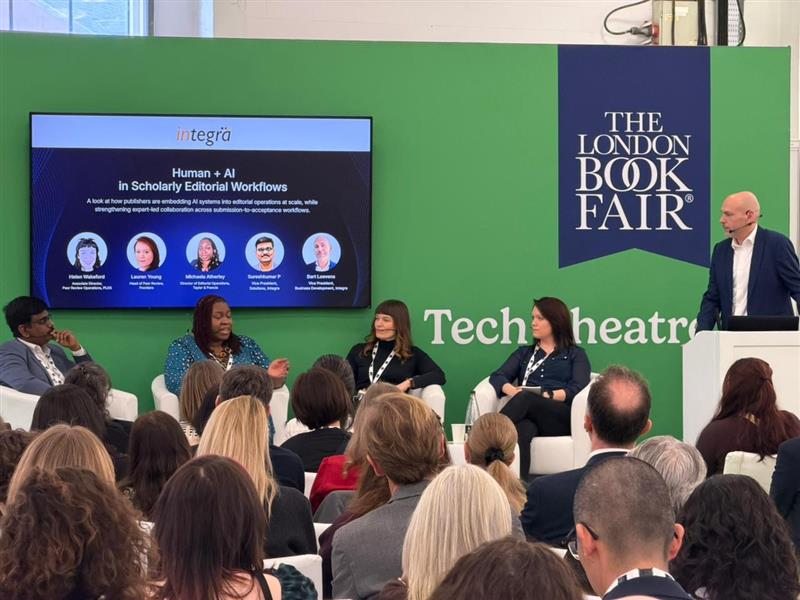
On the afternoon of 10 March, Integra hosted a panel at the Tech Theatre titled “2026 and Beyond: Human + AI in Scholarly Editorial Workflows.” I had the privilege of moderating the discussion, which brought together Michaela Atherley, Director of Editorial Operations at Taylor & Francis; Helen Wakeford, Associate Director of Peer Review Operations at PLOS; Lauren Young, Head of Peer Review at Frontiers; and Suresh Kumar representing Integra.
The room was full, and the conversation quickly moved into practical detail. We addressed where in the editorial workflow AI-assisted screening delivers real value, and how teams should handle cases flagged by automated tools that cannot be resolved through automation alone. The panel was clearly working through them in their day-to-day operations. A consistent theme throughout the discussion was accountability: how to maintain strong editorial judgment as automation becomes more widely embedded in workflows.
What stood out for me was the range of editorial roles represented in the discussion, from submission-stage screening through to acceptance policies, each approaching the same set of challenges from a different point in the workflow.
Three Days at Integra’s Stand
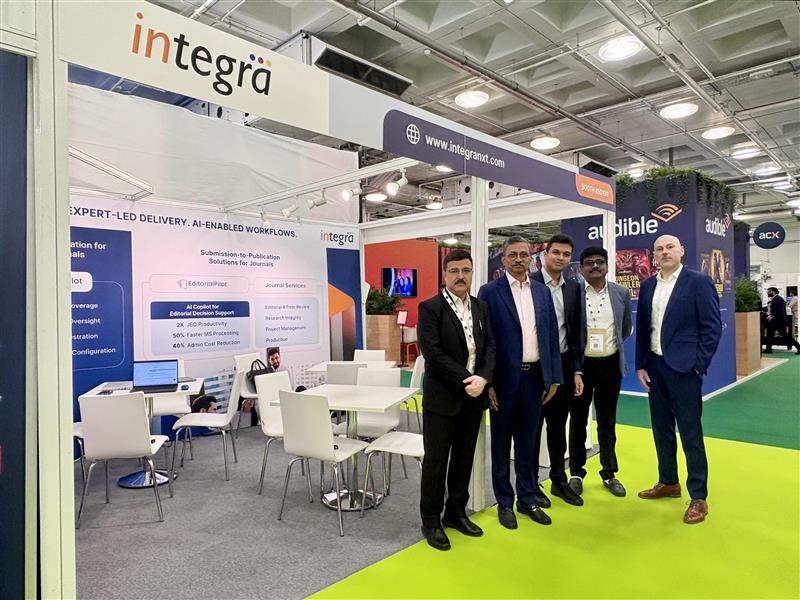
Over the course of three busy days, our team met with publishing partners from across the academic, education, legal, and trade sectors, discussing the challenges and opportunities shaping their work today.
Submission volume came up consistently in our conversations with journal publishers more than anything else. Editorial offices at multiple publishers described a gap that has been widening: manuscript intake has grown significantly, reviewer availability has not kept pace, and author expectations around turnaround have shortened. Teams that managed this informally two or three years ago are now looking for structural answers.
Several publishers had started piloting AI-assisted tools at various workflow stages, but many were still working out where those tools genuinely reduce editorial load and where they add a layer of process that still requires human oversight to manage effectively.
Research integrity was the other consistent theme in our meetings. Publishers described a situation where the volume of flagged cases has grown to the point that the review process itself creates a bottleneck. Detection tools can surface AI-generated content, citation irregularities, and data anomalies, but the editorial judgment required to act on those findings still has to come from a person. Who reviews the flagged cases, with what authority, and on what timeline are governance and resourcing questions that editorial operations teams are actively working through.
Several publishers from the education segment raised questions that connected directly to what we heard at SXSW EDU earlier this month: how to prepare content for AI-enabled delivery while keeping quality and accessibility intact, and how to modernise production workflows without creating downstream risks in the process.
How Integra’s Journal Publishing Services Connect
Our journal publishing services are built around the upstream editorial challenges publishers raised at the fair:
- JEO & Peer Review Services: editorial office support, reviewer coordination, and ethical screening at scale
- Research Integrity Services: checks for AI-generated content, data irregularities, citation anomalies, and paper mill submissions, applied early in the process before problems compound
- Expert Manuscript Review: discipline-level assessment for commissioning decisions and initial triage
The upstream editorial work Integra does with journal publishers addresses the pressures publishers described at the fair. Editorial offices stretched on capacity can draw on our JEO and Peer Review Services, which support growing submission volumes and reviewer coordination without requiring publishers to expand internal headcount in proportion to intake growth.
What We Offer Education Publishers
Integra works with education publishers on the content and production infrastructure to manage the shift to AI-assisted instruction and adaptive learning at the same time as they are rebuilding content workflows for digital-first delivery. At Integra, we believe AI and technology should make education more accessible, not less.
Our content development services span curriculum writing, instructional design, and assessment authoring across K-12, higher education, and ELT programmes. For publishers preparing existing content for AI-enabled platforms, we provide structured content engineering and XML-based production that makes material readable and reusable by downstream systems, without requiring publishers to rebuild editorial processes from the ground up. We design with accessibility as a foundational requirement, ensuring digital equity for all learners through WCAG, Section 508, and ADA compliance built into production workflows.
Continuing the Conversation
LBF 2026 confirmed that journal publishers have entered a practical, operational phase of building editorial capacity for the years ahead. The conversations at the fair were grounded in specific challenges rather than broad speculation—and that is usually where the most meaningful work begins.
We’re continuing many of the discussions that started in Olympia. If we met at LBF and you’d like to pick up where we left off, or if the challenges outlined above are ones your team is currently working through, we’d be glad to continue the conversation. You can reach us at [email protected].
Recent Blogs

Where AI Ends and Editorial Judgment Begins: A Practical Map for the Journal Workflow