
AI-Assisted Translation and Content Review
Native language experts and AI-assisted workflows for multilingual translation, proofreading, editing, and quality validation.
High-volume translation programs face terminology drift, domain errors, and tight timelines. Integra combines AI-assisted translation with multi-step linguistic review and subject checks to improve accuracy, reduce rework, and keep multilingual releases predictable.
Let's TalkScaling Multilingual Publishing Without Editorial Overload
The rapid growth of digital learning platforms and e-books has made native-language access essential to maximizing global reach and learner impact. As AI-assisted translation enters mainstream publishing workflows, many North American and European publishers are unlocking new opportunities in emerging language markets, including South and Southeast Asia, Eastern Europe, and Africa. While AI can significantly reduce first-draft turnaround time, educational and professional content still demands language quality that stands up in classrooms, assessments, and professional learning environments. Common failure points include inconsistent terminology across chapters, misinterpretation of domain-specific concepts, and “correct-looking” sentences that subtly alter meaning that results in rework, reviewer fatigue, and author queries. A controlled workflow that combines AI-assisted translation with specialist linguists, subject reviewers, and measurable quality checks mitigates these risks and keeps large-scale multilingual publishing programs on track.

Key Challenges
Subject Misreads: Technical passages in STEM, business, and finance can be “fluent” but conceptually incorrect without review.
Terminology Drift: AI output can vary across chapters, causing repeated edits and inconsistent usage in instructor-facing materials.
Format Friction: Mixed inputs across PDF and Word increase version confusion and slow approvals when workflows lack control.
Timeline Pressure: Multi-language schedules compress review windows, increasing the chance of missed errors before publication.
AI-Assisted Translation & Review for Publishers
Translation & Localization
AI-assisted and human translation, and expert linguistic validation across a wide range of Indian, Asian, European, Middle Eastern, and African languages, enabling publishers to scale into both established and emerging markets with confidence.
AI Draft Setup
Prepare source files, style guides, and terminology lists, then run AI-assisted translation with controlled prompts and glossary rules. This creates a consistent draft that reduces downstream edits and supports faster multi-language production schedules.
Linguistic Proofing
Proofread AI-translated content for grammar, clarity, and readability, with corrections tracked at the file level. This improves fluency while preserving the meaning, tone, and instructional intent of the English source.
Subject Review
Assign subject reviewers for disciplines such as business, engineering, chemistry, accounting, and information systems. Reviews focus on concept accuracy, term usage, and “false friends” that read well but change meaning.
Quality Checking
Apply a tiered quality model—proofreader, reviewer, and quality checker—with documented checklists and issue logs. This supports consistent outcomes across titles, flags recurring errors, and improves revisions during the project.
Workflow Governance
Run centralized trackers, version control, and daily progress reporting with language coordinators managing queries and feedback. This reduces handoff confusion across teams and supports predictable submissions against aggressive schedules.
To learn more about this service and how it can add value to your goals, let’s schedule a quick conversation. We’d be happy to walk you through the details and answer any questions you may have.
Let's TalkCase Studies

Enabling Scalable Multilingual Publishing Through AI-Assisted Translation Validation
Read More ➜
Why Choose Integra?

Global Language Coverage: Deep expert network for high-volume translation and content review across Indian, Asian, European, Middle Eastern, and African languages.
Education Focus: Workflows fit textbook, higher-ed, and professional learning content across complex disciplines.
Multi-Step QA: Tiered reviews reduce domain errors and improve consistency across chapters and titles.
Robust Project Management: Central tracking and daily coordination keep multilingual teams aligned during compressed timelines.
Frequently Asked Questions
Q1: How does Integra handle subject-specific accuracy in technical and academic content?
Integra assigns subject-aligned reviewers with academic or professional backgrounds in relevant disciplines such as STEM, business, finance, and information systems. Reviews focus on conceptual correctness, not just linguistic fluency, helping identify domain errors that AI and generalist language reviewers may miss.
Q2: Can this service support large backlists or multi-year publishing programs?
Yes. The service is designed for scale and repeatability, making it suitable for large backlists, ongoing series, and multi-year publishing programs. Standardized workflows, shared terminology controls, and centralized governance enable consistent quality across titles, editions, and release cycles, even as volume and language coverage increase.
Q3: Can you handle multi-language publishing programs involving multiple regions at the same time?
Yes. Integra’s workflows are designed to support concurrent multi-language publishing programs across regions such as Asia, Europe, the Middle East, and Africa. Centralized governance, terminology controls, and coordinated review processes help ensure consistent quality and predictable delivery across all languages and titles.
Q4: How is AI translation quality evaluated before human review begins?
Before linguistic proofing starts, AI-translated output is assessed using predefined quality indicators such as sentence completeness, terminology alignment, and contextual relevance. This early screening helps identify high-risk segments that require deeper review, ensuring human effort is focused where it adds the most value and reducing downstream rework.
Q5: How does this approach compare to fully human translation or raw AI translation?
Fully human translation can be costly and slow at scale, while raw AI translation often lacks the accuracy and consistency required for educational and professional use. Integra’s hybrid model combines AI speed with expert validation, helping publishers balance turnaround time, cost efficiency, and quality assurance without compromising academic standards.
Q6: Can you validate AI-translated content in Southeast Asian languages such as Thai, Vietnamese, and Indonesian?
Yes. Integra supports AI-assisted translation and expert linguistic validation for Southeast Asian languages including Thai, Vietnamese, and Indonesian. These languages are frequently used in higher-education and professional publishing programs targeting emerging markets, where terminology consistency and subject accuracy are critical.
Q7: Do you support European and Eastern European languages for academic publishing?
Integra supports a wide range of European and Eastern European languages, including French, German, Spanish, Italian, Polish, Romanian, Hungarian, Czech, and Russian. Validation workflows are designed to maintain academic tone, discipline-specific terminology, and consistency across multi-title publishing programs.
Q8: What types of content formats can be supported in this workflow?
The workflow supports a range of publisher-provided formats, including Word and PDF source files commonly used in textbook and higher education production. Version control, structured tracking, and controlled repositories ensure consistency and traceability even when inputs vary across titles or languages.
Get notified of our latest blogs
Explore Expert Insights
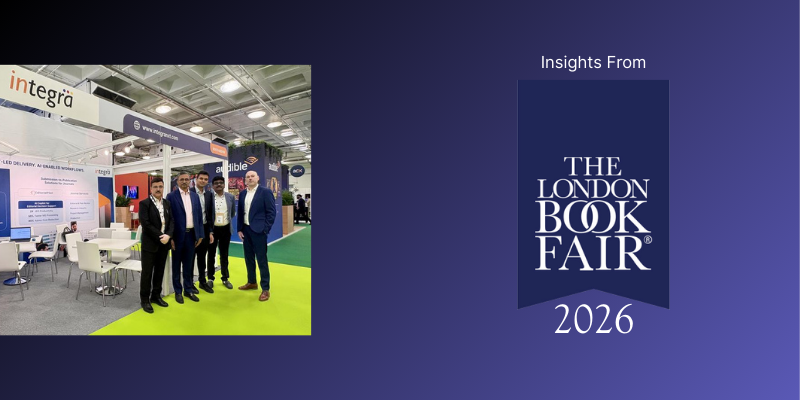
What Publishers Are Navigating in 2026: Insights from Integra at the London Book Fair
London Book Fair 2026 took place at Olympia London from 10–12 March, marking the final year the fair will be held at this historic venue before moving to London Excel...
Read More ➜
Integra at SXSW EDU 2026: AI Hype to Thoughtful Implementation
SXSW EDU 2026 in Austin showed how far AI has moved into the everyday work of teaching, publishing, and product development. Across keynotes, breakouts, and informal conversations, the focus shifted from...
Read More ➜
Beyond the Page – Inclusion, Empowerment, and the Integra Way
A Conversation with Kavitha Jayashankar, Vice President – Human Resources International Women’s Day 2026 Special At Integra, inclusion is not a seasonal theme. It is a sustained commitment, reflected in...
Read More ➜