
ELT Design, Illustration & Typesetting Services
Consistent visual, illustration, and typesetting support for clear, engaging ELT courseware.
Integra supports ELT publishers with structured workflows, careful execution, and consistent quality, helping teams deliver well-designed textbooks that meet diverse classroom needs.
Let's TalkMeeting Complex ELT Design and Typesetting Needs
Design plays a central role in how language learners understand and use instructional materials. Clear visual hierarchy, culturally appropriate imagery, well-paced layouts, and typographic choices aligned to language learning goals help learners follow complex linguistic and conceptual ideas with confidence. ELT programmes also require careful coordination of print and digital components, including embedded interactives, vocabulary supports, transcripts, pronunciation guides, and scaffolded visuals. Managing these elements across multiple production stages places added pressure on schedules, versioning, and review cycles. These operational realities highlight the need for dependable design, illustration, and typesetting support tailored to ELT publishing demands.

Key Challenges
Complex ELT Visual Layouts: Engaging language learning pages require balance among input text, instructional visuals, phonics cues, and practice tasks.
Print–Digital Consistency: Maintaining design and interaction consistency across print, PDF, and digital learning environments increases review complexity.
Cultural and Linguistic Suitability: Illustrations and examples must resonate across learner populations while avoiding bias or confusion.
Versioning Across Editions: ELT courses often have multiple editions (global, regional, language variants), requiring rigorous version control and layout harmonisation.
Production Timelines: Tight academic release schedules and iterative proofreading cycles compound workload on editorial and design teams.
ELT Design and Typesetting Services
Prototype Page Design
Creating early layout prototypes that test structure, pacing, and placement of visuals, tasks, and language supports in ELT course pages to validate readability, instructional logic, and alignment to language outcomes.
Cover and Program Branding
Designing ELT course covers that communicate level, purpose, and pedagogical focus, aligned to curriculum frameworks (e.g., CEFR/ILR) and programme positioning across markets.
Interior Layout Design
Organising text, tables, examples, images, exercises, and scaffolding features to support comprehension, controlled practice, and self-study strategies, ensuring consistency across levels and formats.
Concept Sketching
Developing initial sketches for instructional visuals, icons, scenario illustrations, and contextual scenes that clarify language points and prepare for full illustration development.
Illustration Development
Producing curriculum-aligned artwork and graphics based on ELT heuristics, ensuring visual clarity, cognitive engagement, instructional relevance, and seamless integration with learning objectives.
Template and Style Design
Creating scalable, reusable design templates and style workflows tailored to ELT programmes to ensure visual cohesion, typographic consistency, and efficient production across editions and volumes.
Design and Style Review
Systematic reviews of layouts and illustrations to ensure adherence to approved templates, manuscript intent, house style guides, and ELT pedagogical priorities, including legibility and learner-friendliness.
Galleys to Print/PDF
Managing the entire proofing and QA workflow from galley proofs to final print/PDF deliverables, integrating design, artwork, and layout checks to ensure error-free, publication-ready ELT course materials.
To learn more about this service and how it can add value to your goals, let’s schedule a quick conversation. We’d be happy to walk you through the details and answer any questions you may have.
Let's TalkExplore Case Studies

A US Publisher Overcomes Rights and Permissions Challenges with iRights
One of the largest publishers optimized & streamlined resource & asset management to enhance operational efficiency & expedite turnaround times.
Read More ➜
Culturally Tailored Educational Materials Drive Global Engagement for English Language Learners
Creation of six culturally tailored student books, enhancing global student engagement and comprehension. Read the case study.
Read More ➜
Converting GCSE Past Papers into Structured, Accessible, and AI-Ready Digital Assets
Read More ➜Why Choose Integra?

ELT Publishing Expertise: Design teams familiar with language learning pedagogy and curriculum standards across ESL/ELT markets.
Integrated Editorial & Production Workflows: Coordinated review and production cycles across editorial, design, and digital teams to reduce iteration and rework.
Version Control and Consistency: Processes that support harmonisation across print and digital versions of ELT programmes.
Scalable & Flexible Support: Services that adapt to programme scale, market reach, and multilingual requirements.
Quality Assurance Processes: Structured reviews to ensure typographic clarity, learner accessibility, and publication-ready deliverables.
Frequently Asked Questions
Q1: How do you support ELT design across multiple proficiency levels within the same programme?
ELT programmes often span several proficiency bands, each with different density, pacing, and learner support needs. Design teams apply level-specific layout rules for text load, task spacing, visual scaffolding, and reference tools, while maintaining a consistent programme identity across levels.
Q2: Can design and typesetting workflows accommodate external reviews from ministries or institutional reviewers?
Yes. ELT projects frequently require staged reviews by curriculum boards, ministries, or institutional partners. Design workflows can be structured to support annotated PDFs, tracked layout revisions, and controlled re-pagination, reducing disruption when feedback arrives late in the production cycle.
Q3: How is accessibility handled in ELT design, especially for digital components?
Accessibility considerations are addressed at both layout and asset levels. This includes colour contrast, readable typography, clear navigation cues, alt-text planning for visuals, and compatibility with screen readers where required. These checks are increasingly expected in digital ELT tenders and platform integrations.
Q4: How do you manage illustration reuse and adaptation across global and regional ELT editions?
Illustrations are developed with reuse in mind, separating core instructional visuals from market-specific details. This allows images to be adapted or replaced selectively without redesigning entire spreads, supporting cost control and faster turnaround when creating regional editions.
Q5: Can ELT design workflows support ongoing course updates rather than one-time publication?
Many ELT courses now operate as living products, with periodic updates driven by curriculum changes, platform releases, or market feedback. Design and typesetting processes can be set up to support incremental updates, version tracking, and selective re-export of affected pages or assets.
Q6: How does ELT design account for AI-generated or mixed-source content entering workflows?
As publishers increasingly combine human-authored and AI-assisted content, design teams focus on consistency rather than origin. Layout reviews, illustration alignment, and visual hierarchy checks help ensure that all content—regardless of source—meets the same instructional and quality standards before publication.
Get notified of our latest blogs
Explore Expert Insights
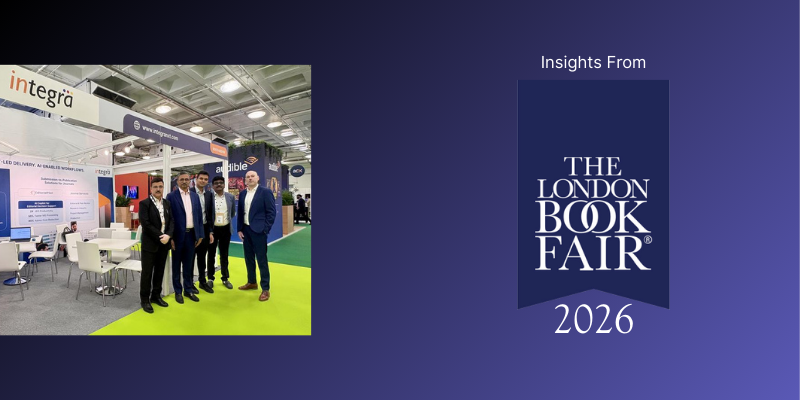
What Publishers Are Navigating in 2026: Insights from Integra at the London Book Fair
London Book Fair 2026 took place at Olympia London from 10–12 March, marking the final year the fair will be held at this historic venue before moving to London Excel...
Read More ➜
Integra at SXSW EDU 2026: AI Hype to Thoughtful Implementation
SXSW EDU 2026 in Austin showed how far AI has moved into the everyday work of teaching, publishing, and product development. Across keynotes, breakouts, and informal conversations, the focus shifted from...
Read More ➜
Beyond the Page – Inclusion, Empowerment, and the Integra Way
A Conversation with Kavitha Jayashankar, Vice President – Human Resources International Women’s Day 2026 Special At Integra, inclusion is not a seasonal theme. It is a sustained commitment, reflected in...
Read More ➜