
High-Precision Data Labelling Services
Accelerating AI models with accurate, scalable, and expert-driven data annotation solutions.
Powering AI with High-Quality Labelled Data
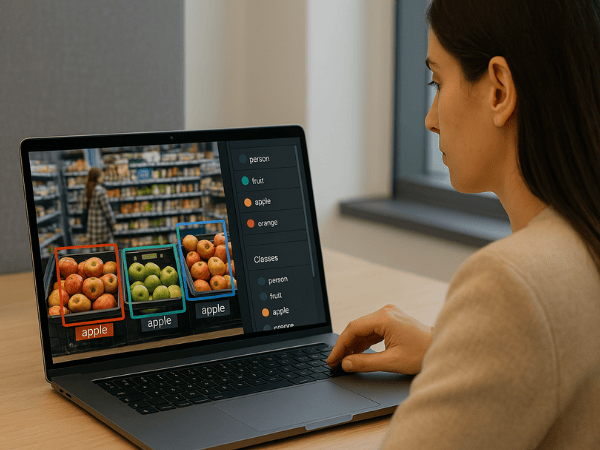
Accurate data labelling is the backbone of AI training, directly influencing model performance and reliability. Poorly labelled datasets can lead to bias, inefficiencies, and suboptimal decision-making. Our data annotation services combine AI-powered automation with human expertise to deliver high-precision labelled data across industries. Whether it’s image segmentation, NLP tagging, or autonomous vehicle training, we ensure consistency, scalability, and compliance with stringent quality standards. By integrating industry-specific taxonomies and bias mitigation frameworks, we help enterprises build robust AI models that drive innovation, efficiency, and real-world applicability.
Label Data with Precision & Scale
AI models depend on high-quality labelled datasets to deliver accurate predictions. Our expert-driven annotation solutions optimize data integrity, minimize bias, and accelerate AI deployment across industries.
Let's TalkIntegra in Action


Secondary-level ELT Course Versioning Under Tight Timelines and Curriculum Change
Read More ➜


Enabling Scalable Multilingual Publishing Through AI-Assisted Translation Validation
Read More ➜
Converting GCSE Past Papers into Structured, Accessible, and AI-Ready Digital Assets
Read More ➜
Identifying Image Alterations: A Systematic Approach to Enhancing Publication Integrity in Scientific Peer Review
This case study explores the systematic implementation of image screening protocols across multiple scientific journals to address image manipulation in scholarly publications.
Read More ➜Our Key Services
Text & NLP Labelling
Structuring unstructured text through sentiment analysis, entity recognition, and intent tagging to enhance natural language processing, improving chatbot accuracy, document classification, and content moderation for diverse industries.
Image & Video Annotation
Delivering pixel-perfect annotations for object detection, segmentation, and activity recognition, enabling high-performance AI models for industries like autonomous driving, retail analytics, medical imaging, and advanced surveillance systems.
Audio & Speech Annotation
Transcribing, segmenting, and labelling audio data to support speech recognition, voice assistant development, and acoustic modelling, covering multiple languages, accents, and domain-specific terminologies for global applications.
Custom Annotation Workflows
Designing flexible annotation pipelines tailored to project needs, integrating AI automation with human oversight to meet quality standards, accelerate delivery, and support industry-specific data compliance requirements.
Want to Know More?
Explore Expert Insights

From AI Governance to Human Agency: What Should Humans Remain Capable of Doing?
AI governance has become urgent across scholarly publishing. Publishers, universities, libraries, funders, societies, and technology providers are writing policies on privacy, security, intellectual property, transparency, bias, accountability, and research integrity....
Read More ➜
Inside Integra’s Publisher Conversations at Frankfurt Book Fair 2026
In our conversations at Frankfurt Book Fair 2026, publishers were giving greater attention to how AI could work securely and effectively within their organisations. Many of those we met were...
Read More ➜
When AI Can Do the Work, What Should Students Still Learn to Do?
A student submits a correct answer to a mathematics problem, complete with a clear worked solution. The answer came from a generative AI tool. The teacher can see the method,...
Read More ➜Tell us how we can support your success
Frequently Asked Questions
Q1: What are data labelling services?
Data labelling services involve annotating raw data—such as text, images, audio, and video—with relevant tags, classifications, or metadata to train machine learning and AI models. This structured data enables models to learn patterns and make accurate predictions.
Q2: What types of data can Integra label?
Integra provides expert labeling for text, image, audio, and video data. This includes entity recognition in text, bounding boxes in images, audio transcription, and frame-by-frame video annotations—covering a wide array of AI training needs.
Q3: How does human-in-the-loop (HITL) improve data labeling accuracy?
HITL ensures that humans validate or correct AI-generated annotations. This approach combines the speed of automation with human judgment, resulting in high-quality, accurate datasets suitable for production-grade AI models.
Q4: Does Integra support labeling for computer vision and NLP projects?
Yes. Integra supports advanced data labeling use cases in computer vision (e.g., object detection, segmentation) and natural language processing (e.g., sentiment analysis, named entity recognition), ensuring your models are trained on precise, context-rich data.
Q5: Can Integra handle large-scale data labeling projects?
Absolutely. Integra has the infrastructure, workflows, and trained workforce to handle high-volume annotation projects efficiently—while maintaining quality through review cycles and strict QA protocols.
Q6: What quality control measures does Integra use for data labeling?
Integra uses multi-layered quality control including expert reviews, consensus checks, sampling audits, and automation-assisted validation. These ensure consistent, accurate, and high-quality annotations across large datasets.
Q7: How is data security managed during labeling projects?
Integra adheres to stringent data security protocols, including NDAs, secure access controls, encrypted platforms, and role-based user permissions to ensure sensitive data remains protected throughout the annotation lifecycle.
Q8: Do you offer custom annotation tools or platform integration?
Yes. Integra can work with your existing annotation platforms or provide custom annotation tools designed to match your specific workflows, model requirements, and integration preferences.
Q9: How can I get started with Integra’s data labeling services?
To get started, reach out to Integra’s team. They will evaluate your data needs, define scope and KPIs, and initiate a pilot or full-scale annotation project tailored to your use case.